Jory MacKay on March 04, 2026
 What is a gap analysis? How to drive meaningful change in your business
Every business leader dreams of healthy revenue, happy customers, and seamless operations. But the reality is often painfully different.
Flatlining sales, messy product roadmaps, and conflicting priorities all point to one thing: a gap between where you want to be and where you actually are.
A gap analysis is a dynamic framework that helps leaders understand both the distance and underlying causes between their goals and reality. While gap analyses are most often used at the business level, they can be applied to nearly any situation where you want to identify opportunities for meaningful change.
Jump to a section:
What is a gap analysis?
A gap analysis is a business technique used to compare an organization’s current performance to its desired goals. The output of a good gap analysis is a roadmap of actions that can be taken to move you closer to your desired end state.
A gap analysis is an honest reality check of how you’re performing to identify where you’re coming up short.
To do this, a gap analysis typically has four key components:
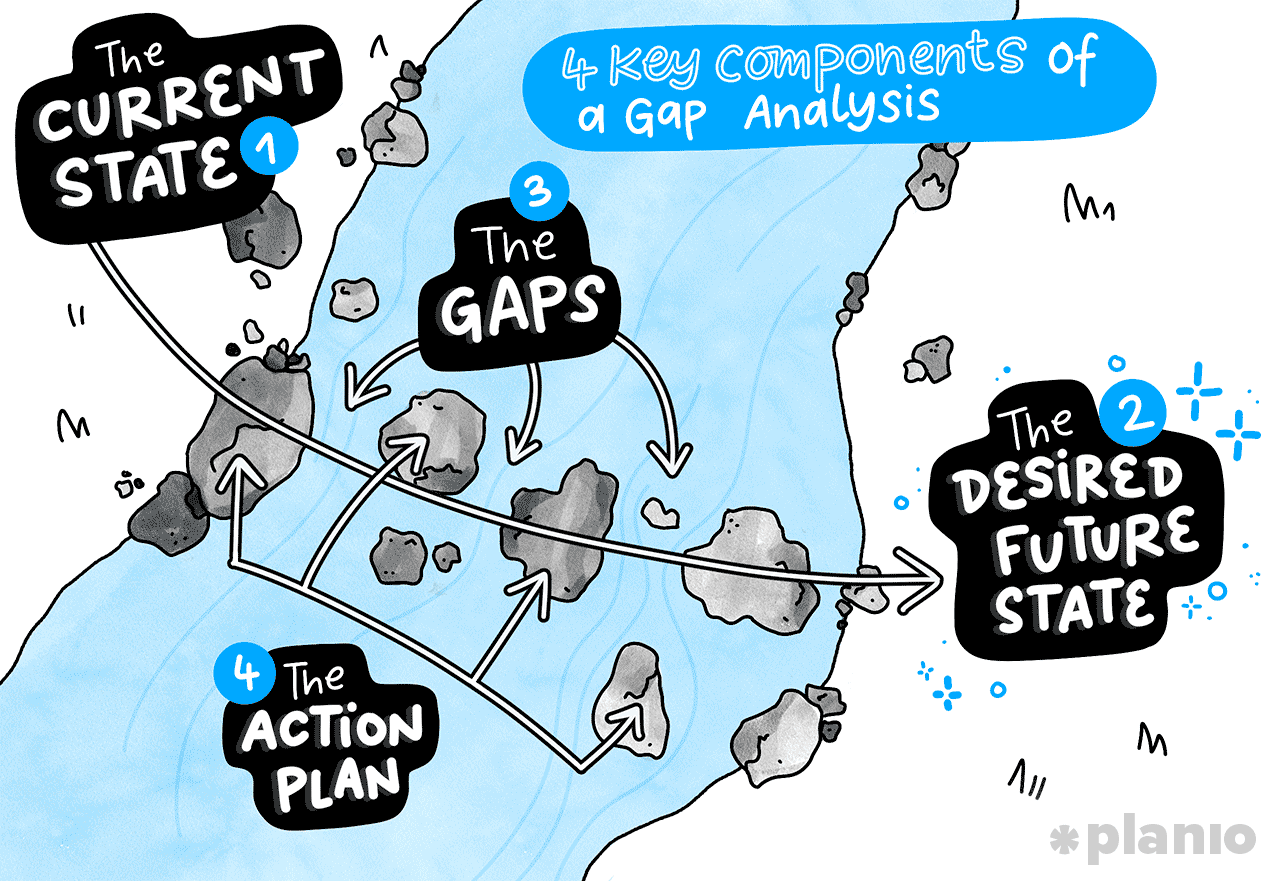
- The current state: The honest, unbiased truth of how things are running right now.
- The desired future state: Where you want to be (backed by North Star metrics, business objectives, and goals).
- The gaps: The specific deficiencies or shortcomings between the current state and the desired future state.
- The action plan: The concrete steps you can take to close the gap and move closer to your goals.
How (and why) is a gap analysis used?
On paper, a gap analysis can seem like a lot of “busy work,” but the effort is worth the reward.
A good gap analysis can help your business by:
- Forcing honesty. You can’t fix what you don’t acknowledge. A gap analysis is an objective, unbiased view of where you are today (warts and all).
- Aligning the team. A gap analysis gives clear outputs, including a research-backed target to aim for. This gives everyone focus on the same business priorities.
- Simplifying priorities. With clear project objectives defined, you stop wasting money (and time) on things that don’t move the needle.
- Looking outward. Unlike other business analysis techniques, a gap analysis forces you to look at best practices in your sector to spark new ideas, strive for innovation, and learn lessons.
- Driving performance. By closing gaps in products, sales, or customer satisfaction, you improve your business’s top and bottom lines.
As we’ve hinted at from the start, “gaps” can hide in any corner of your business. While a gap analysis can be used for any department, process, or product, the most popular use cases include:
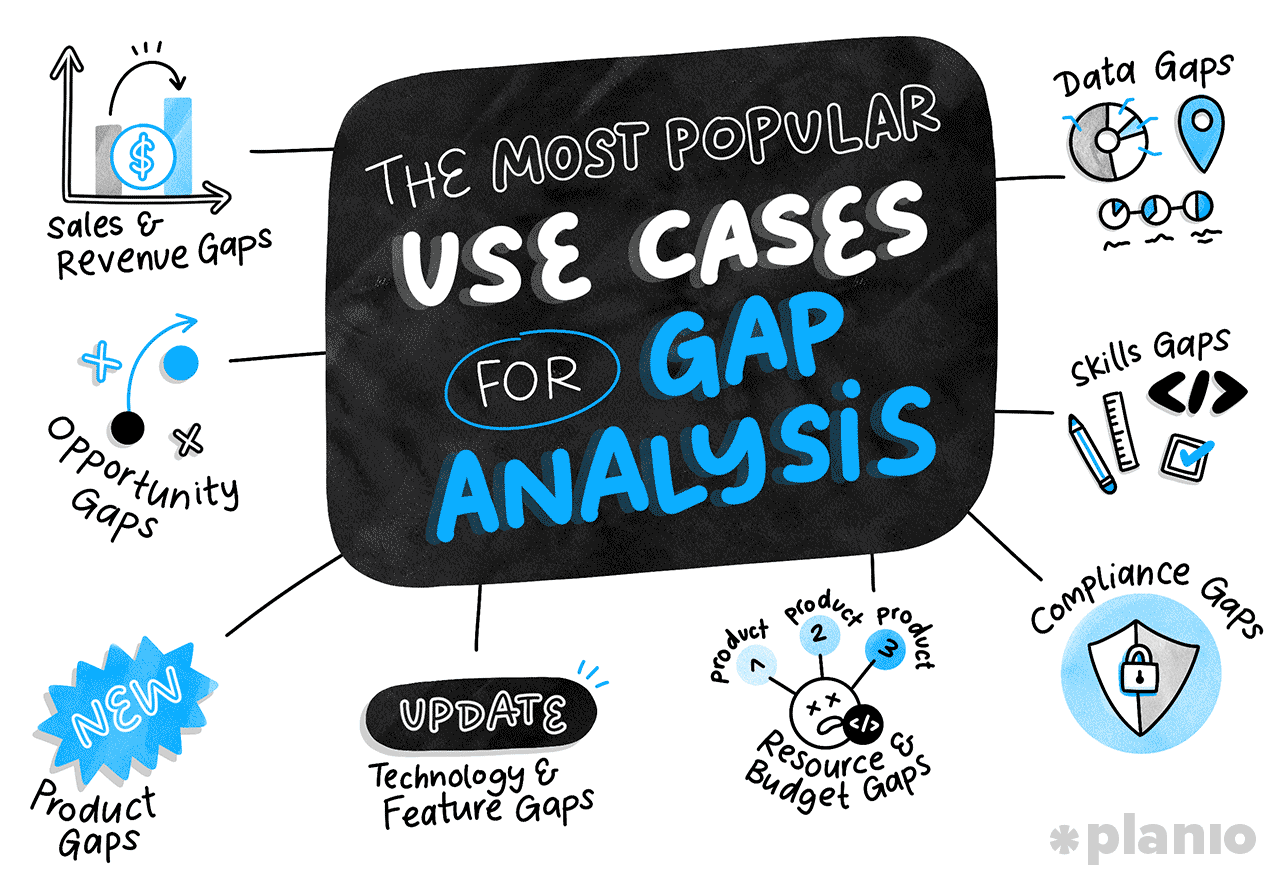
Sales and revenue gaps
Are your sales team hitting their targets? If the target is $100k and they are hitting $70k, that’s a $30k performance gap that needs to be plugged.
Opportunity gaps
Is there a market, expansion, or innovation opportunity you're not fulfilling? Where are/aren't you playing to your strengths and taking the opportunities for growth?
Product gaps
Is there a product or service need you aren’t filling? Maybe your competitors offer a mobile app and you don’t; if so, that’s a product gap to solve.
Technology and feature gaps
At a lower level, are there features or technologies you’re not taking advantage of? Is your legacy software slowing down production while your competitors use AI-driven tools?
Every business leader dreams of healthy revenue, happy customers, and seamless operations. But the reality is often painfully different.
Resource and budget gaps
Do you have the resources (e.g., cash, headcount) to achieve your strategy? For example, you may want to launch three products but only have one developer.
Compliance gaps
Are you meeting the latest ISO standards or GDPR requirements? If not, this might be a costly gap you should look to close as soon as possible.
Skills gaps
Does your team actually have the skills and experience to achieve your goals? According to a 2023 World Economic Forum report, 44% of skills will be disrupted in the next five years — that is a massive gap waiting to happen.
Data gaps
Nowadays, every business is a data business, so do you actually have the information you need to make decisions, or are you flying blind?
While these are just examples, once you understand these core principles, you can stop guessing and start fixing practically any problem in your organization.
7 steps to perform a gap analysis
Like many things in business, a gap analysis is much easier when you have a set process to follow. Luckily, you don’t need to reinvent the wheel. A gap analysis is a tried and tested technique.
Let’s walk through the process, using a fictional case study from “Peak Performance Gear” to bring it to life.
1. Define your business goals and objectives
You have to know where you’re going before you can figure out how to get there. If you haven’t already, start by clearly defining your business goals and objectives, setting a clear target to measure yourself against.
Best practices:
- Set good goals. Use a strong goal-setting framework such as SMART (Specific, Measurable, Achievable, Relevant, Time-bound) to have clear, quantifiable goals to measure against.
- Align goals, strategy, mission, and plans. Ensure the goals you set align upwards with your wider company mission but also downwards with business roadmaps. If things aren’t lined up, it’s going to be difficult to do a proper comparison.
Real-life example:
Peak Performance Gear is a new sports clothing retailer, creating eco-friendly products that help athletes maximize their performance. They have two business goals. The first, is to hit $100,000 in quarterly sales. The second, to achieve an 85% customer satisfaction score.
2. Identify the gaps you’re going to analyze
While a gap analysis can be conducted in pretty much any area, it’s best to keep each analysis tightly focused. This will help keep the quality high and ensure you and your team really focus on where you are today and any underlying issues.
Stop guessing and start fixing practically any problem in your organization.
Best practices:
- Be specific. Pick a specific area of focus such as sales, customer service, or market fit, to get the most out of your gap analysis.
- Engage stakeholders early. As you’re picking your area of focus, engage stakeholders to get maximum buy-in. A gap analysis can feel like you’re marking someone else’s homework, so take the time to explain what you’re doing, and why, to avoid getting any backs up.
Real-life example:
John, the Sales Director, is picking up the gap analysis for sales, as the team is currently stuck at $80,000 per quarter (vs. their $100,000 target). John identifies that while they attract plenty of new customers, very few buy a second time. This is a retention gap.
3. Collect data to inform your current state
This is where the detective work begins as you focus on the cold facts of the performance in your chosen business area. Here, you’ll audit your current processes, interactions, and data to see how things are working day-to-day.
Best practices:
- Vary your data collection. Look at both quantitative data (KPIs, revenue) and qualitative data (customer interviews, team feedback). This will give you a rounded view of the current ways of working and the outputs they create.
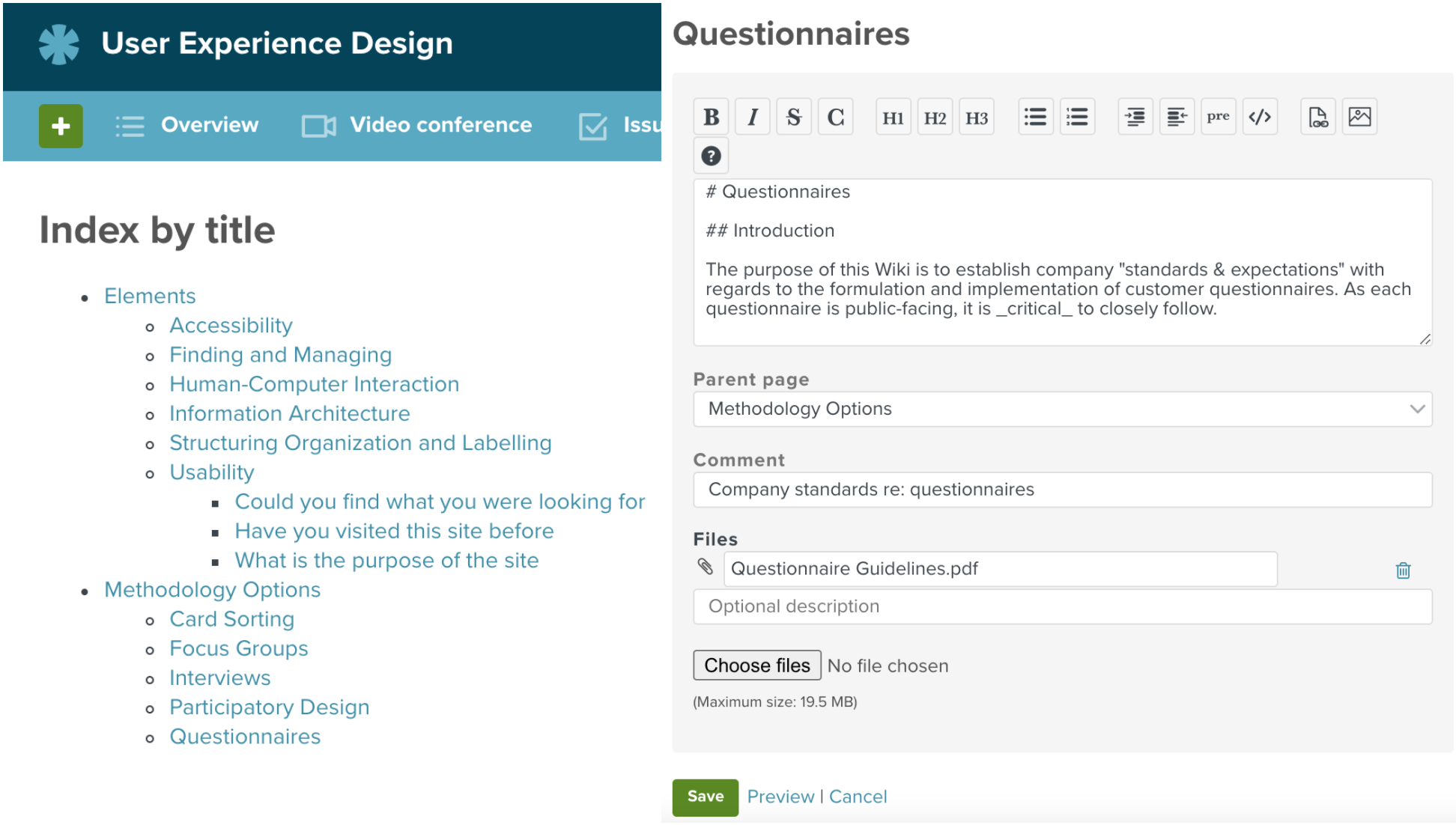
- Centralize your intel. A gap analysis is a data-intensive exercise, but you can make it a whole lot easier by using tools like Planio Wiki to document and gather all of your process maps, customer feedback logs, and performance reports in one place so the entire team can analyze them together as part of your process.
Real-life example:
John dives into Peak Performance Gear’s CRM data and finds that 60% of negative reviews mention “late shipping” with delivery taking 7 working days on average. They also interview their warehouse manager, Christina, who shares insights on current staffing and recruitment issues.
4. Use industry benchmarks to define your desired future state
While you’ll have your internal business goals and targets, you need to understand what good looks like in your industry to bring pragmatism and an external perspective to your gap analysis.
Best practices:
- Perform a competitor analysis. Complete a competitive analysis to uncover what good looks like in your industry. You can also use external third-party reports or industry-standard white papers to supplement your benchmarks too.
- Be realistic. When looking at benchmarks, make sure you’re realistic about what you can achieve and what good looks like for you. After all, not everyone can become the next Apple or Amazon overnight.
Real-life example:
John conducts some research on the sports retail industry and finds the average retention rate is 25-35%, led by big names such as Nike and Adidas, with average shipping times between 2-3 working days.
5. Conduct a root cause analysis to uncover opportunities
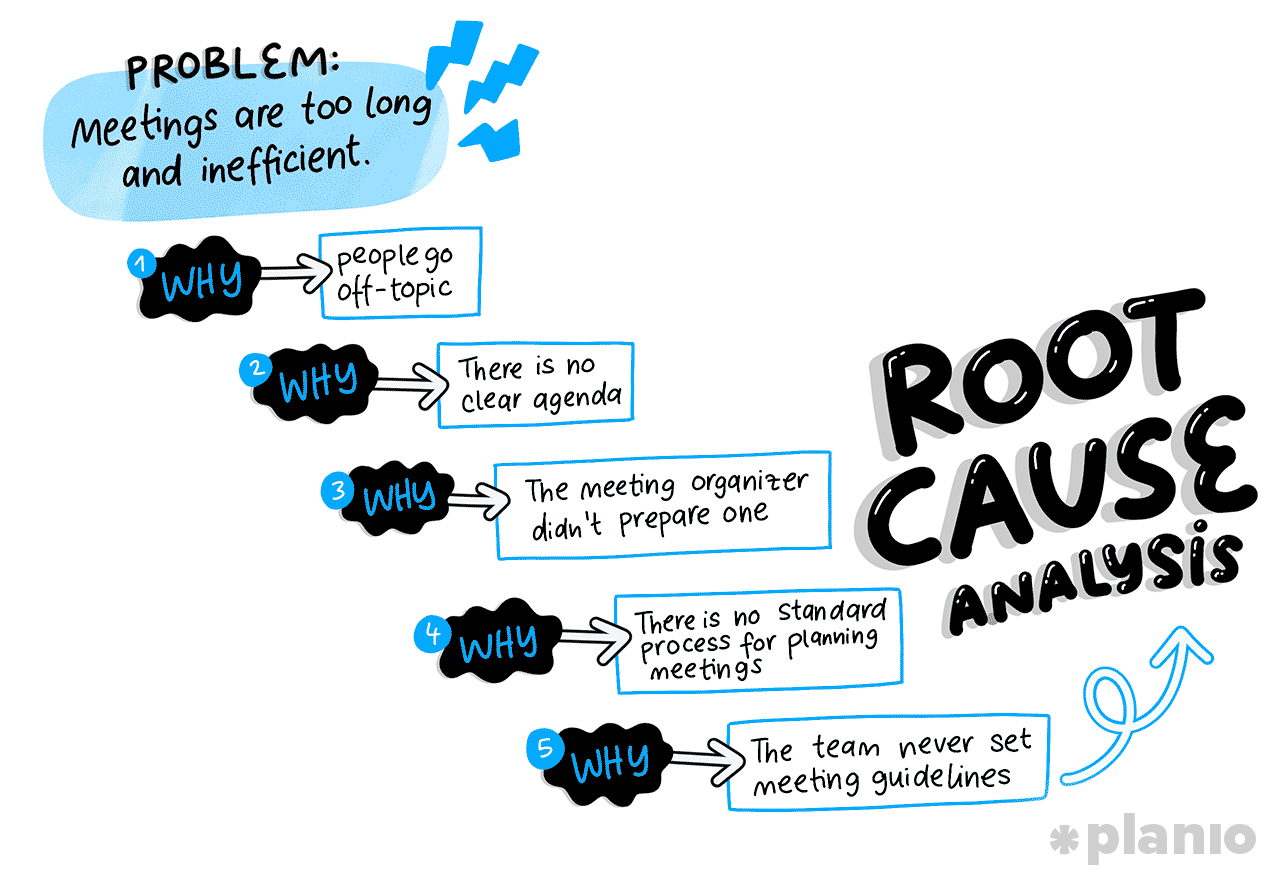
Now that you know the gap exists, it’s time to ask why by diving into the root cause. This is a critical step of the root cause analysis, as if you don’t do this, you’ll simply be putting a sticky plaster over the problem, rather than actually fixing it.
Best practices:
- Repeatedly ask “why?” The "5 Whys" technique is a simple but awesome way to dive into any process improvement or root cause analysis. Just keep asking ‘why’ to get to the nub of the issue.
- Build psychological safety. When you’re identifying root causes, it’s important to take a blame-free approach, focusing on broken processes, not people. This will help you get to the heart of the problem while maintaining psychological safety.
Real-life example:
John gets together with the warehouse manager to dive deeper into the shipping issue. While the team is objectively understaffed, they also discover their inventory software is outdated and their contract with couriers has an 8-day SLA for deliveries.
6. Identify solutions and develop a detailed action plan
With data on your current and desired states, you now have a gap to fill. It’s incredibly rare that a gap has just one solution, so brainstorm ideas, prioritize the best ones, and plan actions to begin moving the needle.
Best practices:
- Prioritize, prioritize, prioritize. Once you’ve come up with potential solutions to close your gaps, prioritize them to decide which to tackle first. A great way to do this is to score them on "Effort vs. Impact", prioritizing quick wins whenever possible.
- Build a robust project plan. Use a project management tool such as Planio to document, collaborate, and plan your solutions. Planio lets you create projects with detailed action plans, assign tasks to different team members, and track their progress on boards or Gantt charts.
Real-life example:
John comes up with three solutions to improve Peak Performance Gear’s shipping and retention issues:
- Hire more warehouse staff
- Renegotiate courier terms
- Upgrade to a real-time inventory management system
They plan to bring in short-term contractors and immediately start negotiations for quick wins. John also writes up a two-year business case to replace their inventory management system.
There is always a difference between “what we are doing” and “what we could be doing”, but the danger isn’t the gap itself; it’s ignoring it.
7. Re-analyze your gaps and repeat the process
The business world doesn’t stand still, and neither should you. Once you’ve implemented some items in your action plan, go back and analyze your current performance. Has it improved and brought you closer to your goal? If there’s still work to do, repeat the process until you’re happy.
Best practices:
- Use objective data to re-measure. After you’ve implemented a change, schedule a "Post-Implementation Review" for 3-6 months after to assess the performance. You and your team will have invested time and effort into your solution, so use data to remove any bias and objectively review the progress you’ve made.
- Treat gap analysis as a cycle, not a one-off event. Gap analysis should be seen as an ongoing framework for improving your business, not a ‘one-and-done’ exercise. There’s a good chance you won’t get it right the first time, so don’t be disheartened and keep iterating until you reach your objectives.
Real-life example:
Six months later, after the new hires and revised courier SLAs, John checks the data. Shipping time has reduced to 5 business days, the retention rate has risen by 5%, and their quarterly sales are up to $93,000. The gap is closing, but now John and the team decide to push ahead with the new inventory system as the final push towards their $100,000 target.
Gap analysis examples: When, where, and how to use them
The beauty of a gap analysis is its versatility, using it to zoom in or zoom out of any business area to improve your performance.
While we’ve used our fictional sales example from Peak Performance Gear, here’s how it might look in other contexts:
Product development
- Current state: Software has limited customization.
- Future state: More options for users to customize the look and feel.
- The gap: Your software lacks a "Dark Mode" that users are screaming for.
- Action plan: Prioritize this feature in the next sprint backlog.
Company strategy
- Current state: Low-cost business that positions itself as budget-friendly.
- Future state: Costs are rising, so we need to adjust prices and positioning.
- The gap: Customer budget-friendly expectations versus cost challenges.
- Action plan: A strategic rebrand to move upmarket and increase prices.
Competitive research
- Current state: Currently have 5% market share.
- Future state: 10% market share and greater brand awareness.
- The gap: Competitor X has a blog that drives 50k visits a month. You have zero.
- Action plan: Conduct a content gap analysis and launch a content marketing strategy.
Project management and planning
- Current state: 75% of projects are delivered two or more weeks late.
- Future state: Reduce late delivery to 15% or less.
- The gap: Project delivery isn’t poor, but estimates are consistently wrong.
- Action plan: Review the work done in the Analyze phase to improve estimates.
Employee turnover
- Current state: Employee turnover has spiked to 20%.
- Future state: Want to be at the industry benchmark of 8%
- The gap: Lack of career development and support for employees.
- Action plan: Implement a new mentorship program for junior and mid-level staff.
3 more business analysis tools you can use today
Gap analysis is powerful, but it’s not the only tool in the shed. Sometimes you need a different lens to see the problem clearly.
Here are three alternative frameworks that complement a gap analysis perfectly:
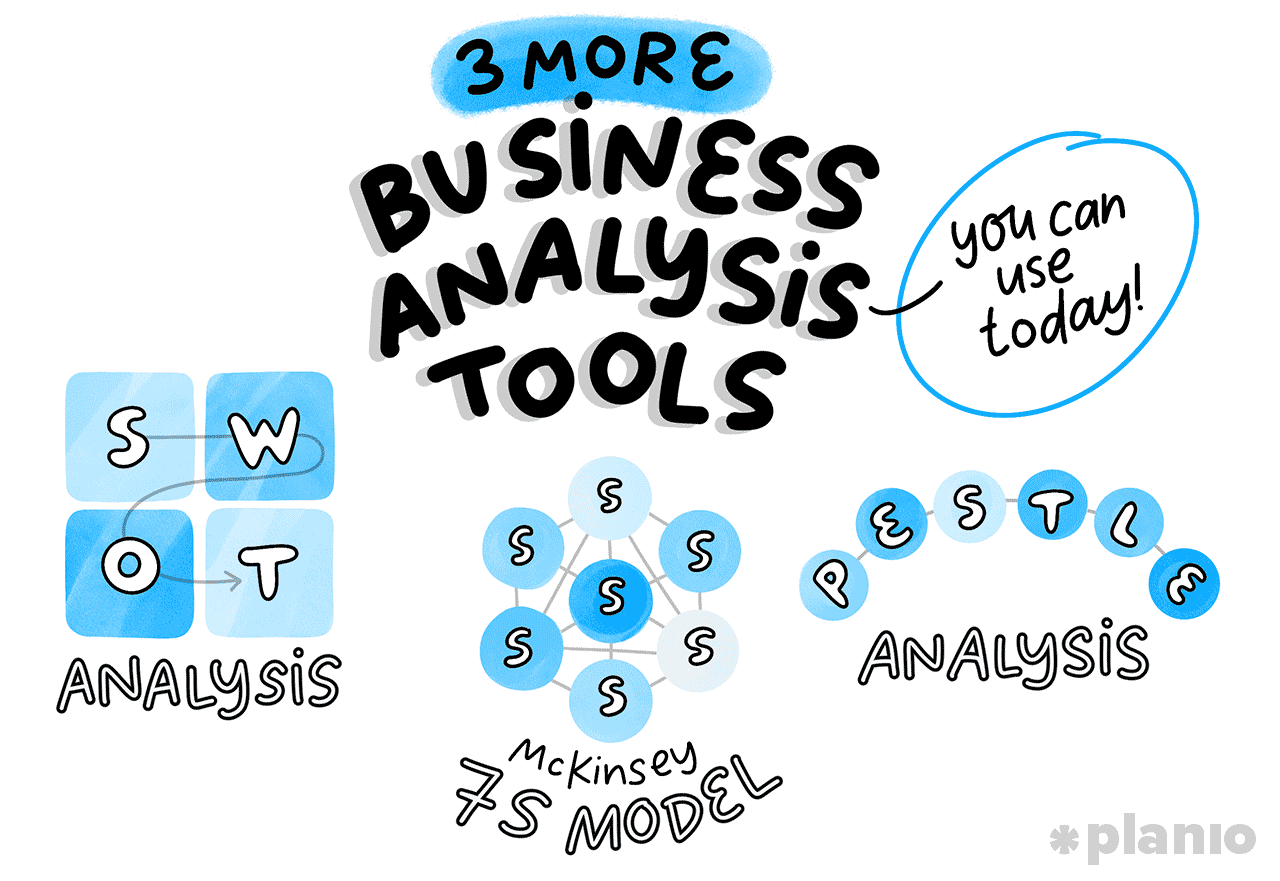
1. SWOT Analysis
What is it? SWOT is a framework to evaluate an organization’s internal Strengths, Weaknesses, Opportunities, and Threats.
What’s it best for? Providing a high-level overview of your current organizational position and identifying strategies to help you move forward into the future.
How can it complement a gap analysis? Use it to better understand your current state, uncovering where you’re doing well and where you can improve for the future.
2. McKinsey 7S Model
What is it? Analyzes the seven key elements and interdependencies of an organization, especially in light of organizational change — Strategy, Structure, Systems, Shared Values, Style, Staff, and Skills.
What’s it best for? Seeing your organization through multiple lenses to uncover areas for opportunity and gaps in your current operating model.
How can it complement a gap analysis? Use it to better understand your current state as well as supporting you to think about alternative solutions when making an action plan for change.
3. PESTLE Analysis
What is it? A framework used to analyze an organization’s external environment, considering factors such as your Political, Economic, Social, Technological, Legal, and Environmental environment.
What’s it best for? Seeing outside your organization to analyze your macro environment.
How can it complement a gap analysis? Use it to support your desired state benchmarking. It can support competitor analysis as well as identify market trends and factors that can create risk and opportunity.
The bottom line: A gap analysis can bring your company to the next level
Gaps exist in every company, from Fortune 500 giants to scrappy startups. There is always a difference between “what we are doing” and “what we could be doing”, but the danger isn’t the gap itself; it’s ignoring it.
A gap analysis is the perfect tool to help you identify your gaps and put a dedicated action plan in place to close them. Do it effectively, and you’ll move away from where you are now and towards where you want to be.
Remember, you’ll need a place to organize your findings, manage your action plan, and keep your team aligned. Planio helps teams run projects, gather data for gap analysis, and stay on track with powerful knowledge management, task management, and team collaboration features.
Try Planio with your own team — free for 30 days (no credit card required)