Jory MacKay on October 28, 2026
How to use product analysis to build better features (free template)
🎁 Bonus Material: Free Product Analysis Template
Building great products is hard. While every founder and product leader wants to build products and tools that users will love, prioritizing what to make can sometimes feel like throwing darts in the dark.
Guessing what to build isn’t just chaotic, it’s bad for business. Research has found that data-driven roadmaps drive a 24% higher growth rate.
Sustainable businesses have processes in place — using qualitative and quantitative data, rather than gut instincts — to help them understand user wants and needs.
This is where product analysis comes into play.
Jump to a section:
In this guide, we explore the essential components of the product analysis process, walk you through a step-by-step framework, and provide a free product analysis template so you can get started today.
What is product analysis? Why is it important?
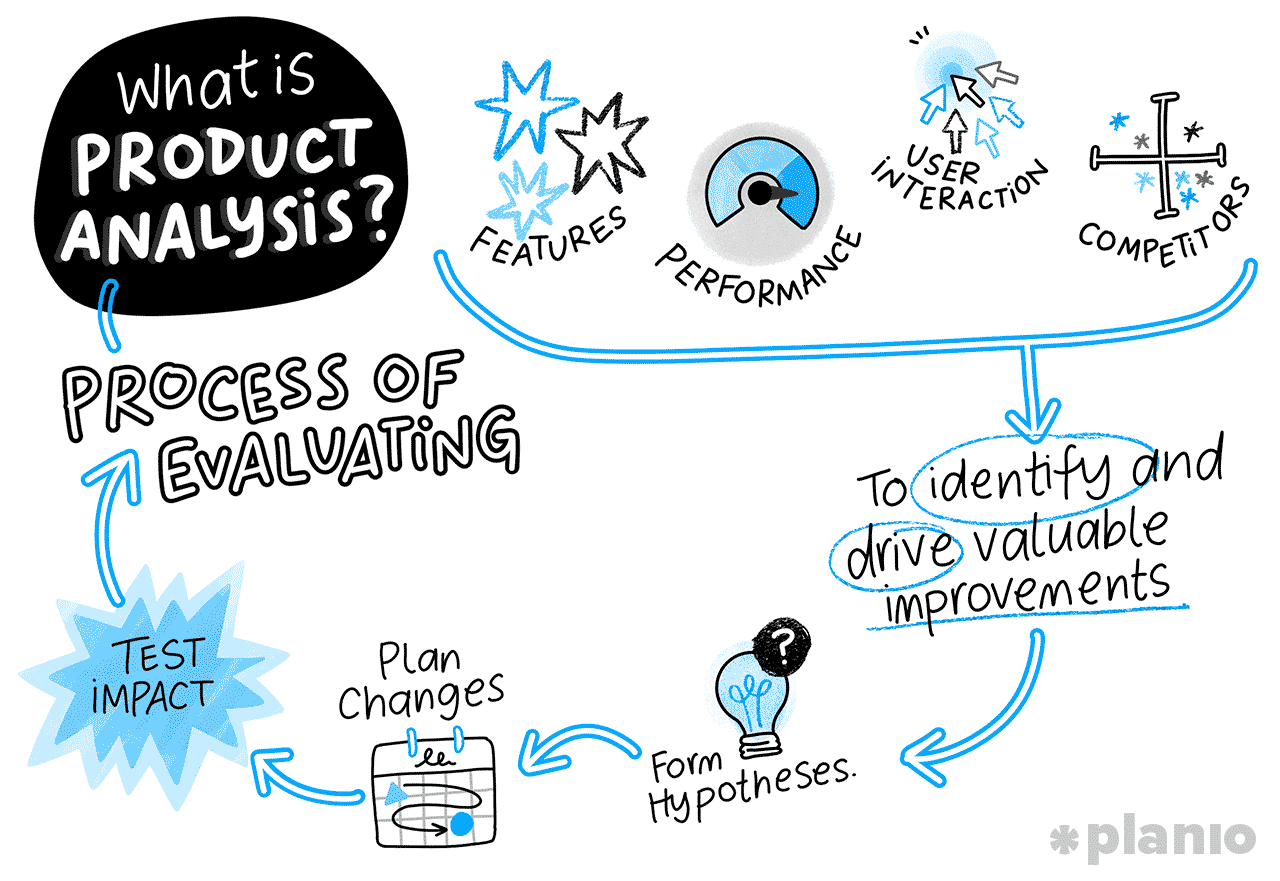
Product analysis is the process of evaluating a product’s features, performance, user interactions, and competitors to identify and drive valuable improvements.
The best product managers know that product analysis isn’t a one-time exercise — it’s an ongoing cycle of gathering data, forming hypotheses, planning changes, and testing impact.
With the rise of AI-driven tools, low switching costs, and high customer expectations, understanding your customers and meeting their needs has never been more important.
Put simply, if your product is clunky, users won’t send support tickets anymore; they’ll just sign up for your competitor’s trial instead.
Good product analysis is all about balance. Rather than solely looking at heatmaps or listening to a few vocal community members, it’s important to get a balance of both quantitative and qualitative data.
Effective product analysis provides a whole range of benefits to your team and company, including:
- Building more user-centric products. Rather than building what you think is right, you actually start solving real customer problems. This boosts satisfaction, adoption, and retention.
- Prioritizing the right features. Using data helps you prioritize the things that matter to customers, not your noisiest stakeholder.
- Empowering targeted marketing campaigns. Understanding which features drive the most value also benefits your product marketing strategy.
- Driving continuous improvement. Good and regular product analysis helps you create a culture where “good enough” is replaced by continuous improvement.
- Reducing customer churn. When you build products that customers love, they have no need to leave, reducing your churn and improving retention.
- Shortening the sales cycle. Product analysis can help customers see value faster, taking pressure off your sales team or marketing efforts.
- Optimizing resource allocation. Empowering engineering teams with real data makes it easier for them to focus on high-impact tasks over low-value nice-to-haves.
The bottom line? Product analysis takes the guesswork out of product management. It brings you closer to your users, uncovering the objective evidence you need to build products that customers want before they even realize they want them.
Good product analysis is all about balance.
The core components of proper product analysis
Product analysis isn’t a single metric; it’s a synthesis of various data points and insights to give you a holistic view of our product’s health and future roadmap.
To achieve this, you’ll need to look at these eight components:
1. Customer insights
What it is: The quantitative and qualitative feedback gathered from surveys, interviews, and support tickets.
Why it’s important: This opens a door into your customer’s “why”, uncovering what’s most important to them, what’s working, and what isn’t.
2. Product analytics
What it is: The quantitative data — clicks, hover times, conversion rates, and drop-off points from your current product.
Why it’s important: This is the “how” of your current baseline. This shows how your product is being used today, where it’s working well, and where there are some pain points.
3. Market analysis
What it is: Broader insights into your industry, market and wider political, technological, or societal changes that might influence your thinking.
Why it’s important: The world around you shapes your user’s opinions. Being up to date helps you plan your next move and keep up with changing expectations.
4. Competitive research
What it is: Tracking what your rivals are doing. Not to copy them, but to find the gaps they’ve missed.
Why it’s important: Two reasons. Firstly, your competitors might be ahead of the curve, so these insights could help you catch up. Secondly, it creates insights into key USPs, or differentiations, that could be crucial for marketing strategy.
5. Technical performance
What it is: Monitoring load times, server uptime, and bug reports. A great feature is useless if it’s slow.
Why it’s important: “How” something works is as important as “what” it does. This stops you from tripping over your feet and keeps you tuned in on performance.
6. User persona mapping
What it is: Revisiting who our users actually are. Has our “ideal customer” changed since we launched?
Why it’s important: User personas are essential for sales, marketing, and product teams alike, so keeping yours refreshed means everyone’s focusing on the same customer.
7. Financial metrics
What it is: Analyzing metrics such as ARPU (average revenue per user), LTV (lifetime value), and CAC (customer acquisition cost) in relation to new feature ideas.
Why it’s important: At the end of the day, you’re running a business, and you need to be profitable to stay in operation. Product analysis needs to consider financials to create a well-rounded view.
8. Feature adoption rates
What it is: Lastly, once you’ve come up with a great idea, you need to measure what percentage of your user base actually uses that new feature.
Why it’s important: It’s a key measure of success but also highlights where you may have inaccurate data floating around that requires re-analysis.
How to do product analysis in 8 steps
Product analysis can quickly become complex. The best place to start is by gathering information using a well-defined product analysis template.
Here’s a step-by-step process for conducting a thorough product analysis:
1. Define your scope, objective, and success metrics
Before jumping headfirst into a product analysis, it’s important to step back and ensure you’re clear on exactly what you’re doing. Prevent “analysis paralysis” by narrowing your focus to a particular product flow, product element, or user base.
Key actions:
- Set the project’s scope: Decide if you are analyzing the whole product or just a part of it (e.g., the checkout flow).
- Align with objectives: Align the objectives of your analysis with your product strategy by selecting an objective you’re looking to solve (e.g., “Increase sign-up conversion by 5%”).
- Agree with stakeholders: Document your scope in a statement of work and align it with stakeholders for agreement.
Best practices:
- Start small: If you’re new to product analysis, start small to ease yourself into it. It’s better to fix one specific flow or use case than to half-analyze your entire product.
- Make a plan: Our guide on how to create a project plan can help you to create a structured plan to approach any task, including an analysis.
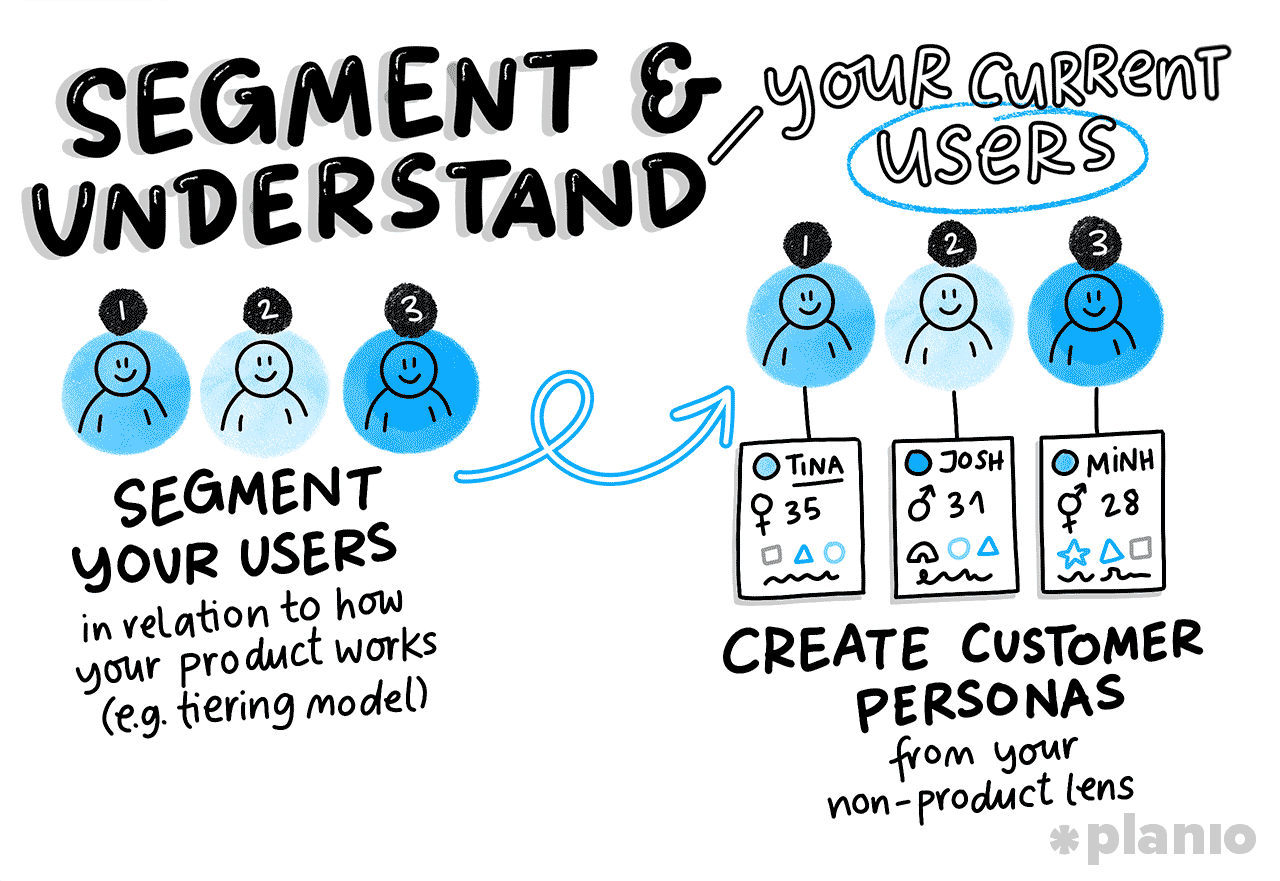
2. Segment and understand your current users
To ensure you are analyzing your product through the right lens, first make sure you have a crystal-clear view of who your current and ideal users are. This can be done through user segmentation, creating your ideal customer profile, or some new user research.
Key actions:
- Segment your users: Firstly, think of your user base in relation to how your product works. For example, your tiering model (e.g., Free vs. Pro vs. Enterprise) might be a good place to start.
- Create customer personas: Then, think about it from your non-product lens by creating customer personas. You could do this at a personal level (e.g., Target-Focused Commercial Directors) or a company level (e.g., Growth Focused Startups) depending on whether your product is B2C or B2B focused.
Best practices:
- Don’t create too many segments or personas: Typically aim for 3-5, extending to no more than 8 if your customer base is varied, plotting them on a perceptual map.
- Ideal customer profile: Customer personas and ideal customer profiles are basically the same thing, so check out our Ideal Customer Profile guide to help you go through it step-by-step.
3. Get an outside view with competitor analysis
With your customers defined, it’s time to start thinking about the broader market. Looking across your industry and your competitors helps get an insight into others’s thinking, what’s working, what isn’t working, and how you can stand out.
Key actions:
- Review website and marketing copy: Start by looking at your competitor’s websites and marketing materials. Identify their messaging, key features, and testimonials to see where they focus and the areas their users love.
- Secret shopping: Then, take it one step further by signing up for competitor products. Put yourselves in the shoes of the users and check out feature sets, onboarding experience, and support functions to see where they provide the most value.
Best practices:
- Use poor reviews to your advantage: Browse through competitors’ one-, two-, and three-star reviews on sites such as G2 and Capterra to see where they are failing their customers.
- Competitive analysis: Learn more about the world of competitor analysis, including free templates and examples, in our competitive analysis deep dive.
4. Dive into other internal data sources
With the bulk of the analysis of users and competitors completed, it’s time to supplement that with any other data you have on hand. This is where collaboration with your marketing and engineering teams is key to help you build a full and rich picture.
Key actions:
- Connect with tech, sales, and marketing teams: Look at support logs, sales call recordings, performance logs, and churn exit surveys to really understand your current product performance.
- Come to grips with your financial situation: It’s important that your product is making money for your company. Partner with your finance team to understand key metrics such as LTV (lifetime value) and CAC (customer acquisition cost) as well as any financial goals your product needs to support.
Best practices:
- Trust what your customers are actually saying: Your support team knows the product’s pain points better than anyone, as they spend all day hearing them. Buy them a coffee and ask what the #1 complaint is.
- Customer acquisition: Understanding how customer acquisition works (and is going for your product) is a key part of your analysis, as it highlights pain points and barriers for your product. Learn more about how to do customer acquisition the right way.
5. Generate product improvement ideas
Now that you have all the data (customer, competitor, and internal), you should have a pretty good idea of where your product can deliver more value. Create a backlog of ideas ready for refinement and analysis with your stakeholders.
Key actions:
- Create a product backlog: This list of ideas is essentially V1 of your new product backlog, ready for refinement and analysis.
- Conduct an initial validation and triage session: Sit down with your wider team of stakeholders (including a mix of engineering, marketing, and customer support) to complete a high-level validation of the ideas. Test them against the data you’ve collected to weed out any non-starters.
Best practices:
- Use good Agile practices from the start: For example, write your ideas in an “if then” format (e.g., if we simplify the navigation, then user session length will increase by 10%). This will help down the line with development.
- Idea validation: There are many ways you can validate your ideas to help you create a shortlist. Check out some of the best in our guide on how to validate new product ideas.
6. Stress test your shortlist with customers
Once you’ve whittled down your shortlist internally, it’s time to hear from the most important group: your customers. This additional validation is key as a final sense check that you’re on the right track, as well as gaining any specific feedback to help you shape each new feature.
Key actions:
- Conduct user interviews: Speak directly with users to better understand their thoughts on your ideas.
- Run surveys and competitions: When you have many ideas or would like a larger sample size, incentivized surveys with some sort of reward can help you to gain mass feedback.
Best practices:
- Don’t lead the witness. Let the user talk 80% of the time and use open questions such as ‘What do you think of this feature?’ or ‘How could it be improved?’ to gain unbiased opinions.
- Master user interviews: Whether in person or remotely, use our guide on how to run better user interviews to perfect your interviewing techniques.
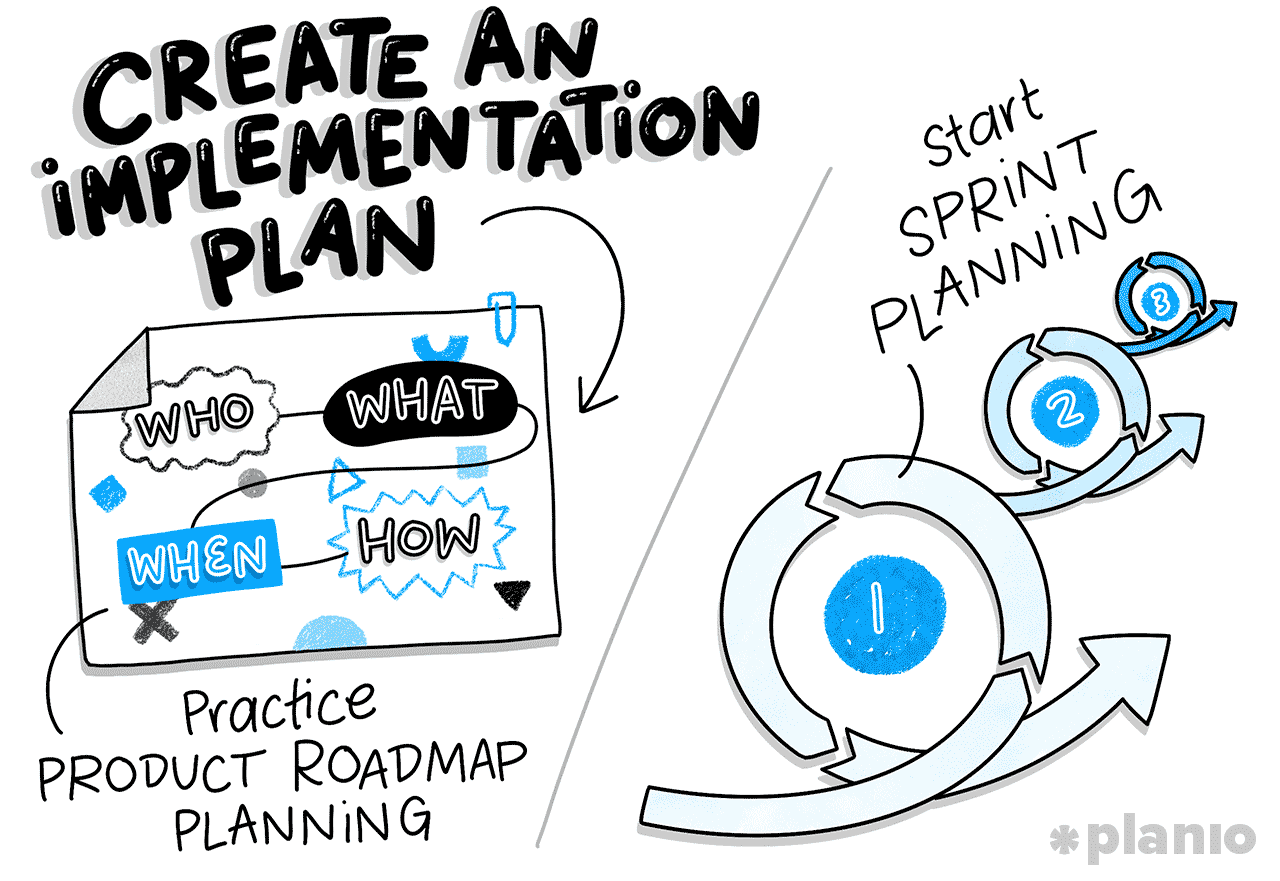
7. Create an implementation plan
With your validated list of ideas, it’s time to start forming a plan to get them live. This is where product and project management really merge by pulling together a detailed plan to track the implementation of each new feature.
Key actions:
- Practice product roadmap planning: At the highest level, now’s the time to create a refreshed product roadmap. It’s a great resource to show the strategic direction of your product and keeps stakeholders up to date without going into the weeds.
- Start sprint planning: Below your product roadmap you’ll begin breaking your features down into items of work. As part of this, you can plan each of your fortnightly or monthly sprints, showing which items will be worked on when.
Best practices:
- Stay high level: In true Agile fashion, it’s best to keep your product roadmap as high-level as possible, giving you space to flex and adapt as new information emerges.
- Use the right tools: This is the point of the process where project management tools like Planio can really make your life easy. With Planio you can organize your entire development process, creating a backlog of items, planning them into sprints, and keeping track of your team’s progress all from one place.

Get organized today by trying Planio free for 30 days (no credit card needed).
8. Iterate, launch, and refine with customers at the center
As you move through developing your new product roadmap, remember that product analysis is an ongoing exercise. You should be regularly checking in with your customers to understand if their priorities or needs have changed and to get early views on any of your new features.
Key actions:
- Use prototypes to refine concepts: When turning your backlog ideas into real features, creating prototypes using UI/UX wireframes, no/low-code MVPs, and test sites helps you create something tangible without investing too much effort.
- Create superuser communities: Most successful product teams have a community of power users to be their initial sounding boards or testers for new ideas. This helps you get fast feedback and improve on your new ideas.
Best practices:
- Be patient: Remember that launching new features is as much about training, communication, and adoption as it is about development. Don’t be alarmed if your new feature isn’t the #1 most used in week one. Instead, focus on offering additional support to help your users learn it.
- Embrace feedback: Like anything new, you won’t get product analysis right the first time. Make feedback your superpower by checking out our guide on giving and receiving great feedback.
6 real-world product analysis examples
If product analysis still feels big and scary, remember you can break product discovery down to just look at a particular component.
Here are some examples of ways you can break the product down to get hyper-focused:
- Customer journey analysis. You could focus on a specific customer journey (such as onboarding or payment) to get close to a specific part of your product that’s causing pain.
- Retention analysis. Retention is a big thing for products, so you can dive into why users stay. If a user survives the first 30 days, what specific features did they use that the churned users didn’t?
- Usage analysis. A common killer of products are "Zombie Features" — features that took months to build but are only used by 0.5% of your audience. You could focus on those to streamline or simplify your product.
- Cohort analysis. Comparing different groups of users (e.g., users who signed up in January vs. February) is a great way to drill down into product specific product updates for your roadmap.
- Product marketing analytics. Here you can analyze the effectiveness of your product’s marketing strategies. This could help you better understand messages and pain points that resonate with users to better optimize your sales and onboarding experiences.
- Attribution analysis. Attribution analysis helps understand which marketing touchpoint or feature was the “tipping point” that convinced a user to sign up or upgrade.
The best products in the world weren’t built on a series of lucky guesses. They were built on a foundation of rigorous, ongoing product analysis.
Avoid these common product analysis pitfalls
Even the best product managers with the most polished product analysis can get things wrong. Here are some common traps to watch out for when planning your next product analysis:
- Gathering too much data. While product analysis data is important, too much of it can lead to "analysis paralysis". Once you have a clear picture of your users’ needs, just get on with developing new valuable features rather than diving deeper and deeper into data.
- Letting your unconscious biases beat out customer data. Many product managers aren’t in the same demographic as their target audience, meaning you have to work hard to keep your own personal bias out of the decision making. If you don’t, you’ll make a great product for you, but no one will buy it.
- Ignoring the "silent majority". Don’t just build for the three people who scream the loudest on X or Reddit. Use your analytics to see what the quiet users are doing, too, to ensure you build a well-rounded product that helps everyone.
- Not looking at your product holistically. A feature might look great in isolation, but if it breaks the logic of the rest of the app, it’s a net negative. Make sure you consider things in the round to stop you inadvertently creating bugs and issues.
The bottom line: Products either evolve or die
The best products in the world — the ones we can’t imagine living without — weren’t built on a series of lucky guesses. They were built on a foundation of rigorous, ongoing product analysis.
When you take the time to marry quantitative data with genuine human stories, you’re far more likely to build a product your users love.
But great analysis is worthless if the results sit in a forgotten PDF.
Planio helps teams bridge the gap between insight and action. By centralizing your product roadmap, running organized sprints, and trackable tasks and milestones, you ensure that every team member is pulling in the same direction.
Ready to start your next product analysis? Give Planio a try for free for 30 days — no credit card needed!