Jory MacKay on August 05, 2026
 What is a business objective? 5 real-world examples
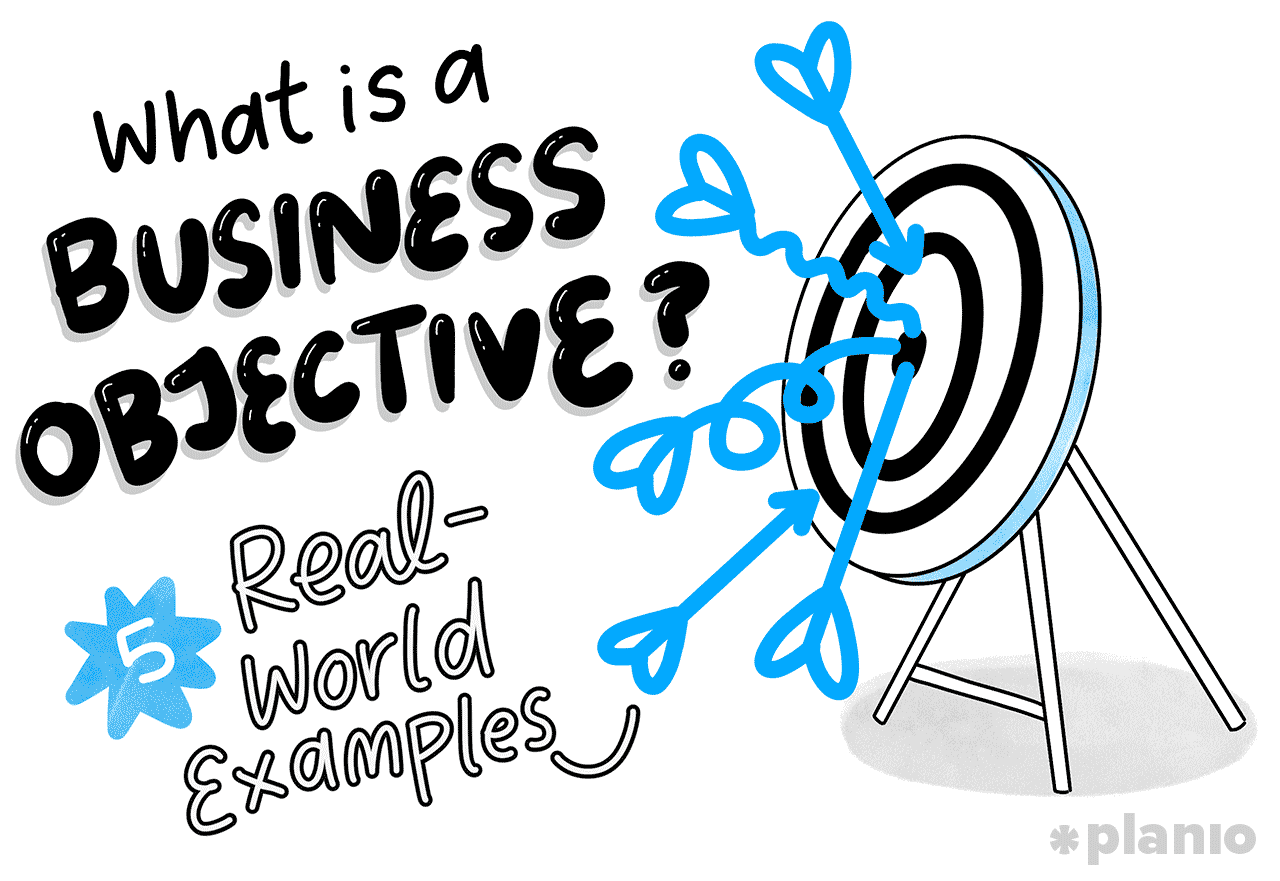
As a founder, team leader, or manager, you’re responsible for steering the ship. But, in a world obsessed with frameworks and acronyms — from OKRs, to KPIs, MBOs, BHAGs, and more — it’s easy to get muddled and lose clarity when setting objectives.
Business objectives are the high-level targets that create a bridge between your strategic vision and the day-to-day projects your team works on.
Choosing the right business objectives puts you on the path towards becoming the type of company you want to be, while providing the direction employees need to manage, prioritize, and succeed in their work.
In this article, we’ll strip away the jargon and provide a clear, concise guide to business objectives, including what they are (and aren't), why they are so critical for your company's success, and how to set and manage them yourself.
Jump to a section:
What is a business objective? How and when to use them
Business objectives are the high-level targets that provide the bridge between your strategic vision and the day-to-day projects your team works on.
Much like other goals, they should follow the SMART framework — driving towards a specific, realistic, and measurable achievement within a set timeframe.
Here’s an easy way to think about how business objectives fit into your company’s larger goal-setting framework:
- Your vision is your ultimate destination — for example, “A world with sustainable energy”
- Your mission is your vehicle — for example, “We build the world’s best electric cars”
- Your business objectives are the quantifiable milestones on the map — for example, “Reach a production capacity of 10,000 cars per year by 2030”
It’s easy to get objectives mixed up with goals, strategies, or mission statements. As Esther Han from Harvard Business School explains, the key difference is hierarchy and duration:
“While your more tactical goals might shift quarterly, your high-level objectives generally won’t change until there’s a major organizational shift.”
Here’s a simple breakdown of where objectives sit in that hierarchy:
| Vision | Mission | Business objectives | Strategy | Tactics | |
|---|---|---|---|---|---|
| What is it? | The ultimate “why” | The “what” and “who” | The high-level “where” | The “how” | The specific “steps” |
| When to use | Company inception | Company inception | Strategic planning sessions | Strategic planning sessions | Quarterly, monthly, or weekly |
| Format | Inspirational guiding statement | Public-facing company definition | 3-5 company-wide priorities | Specific plan or approach | Project plans, roadmaps, and tasks |
| Strengths | Highly motivational | Creates a sense of purpose | Focuses company | Provides a plan of attack | Highly actionable |
| Weaknesses | Unactionable on its own | Not actionable | Too high-level without a strategy | May not adapt to market changes | Can lead to “busy work” if not aligned |
The most action-oriented businesses can sometimes use two layers of business objectives, short-term and long-term, to further help connect the dots between the vision and mission and day-to-day project objectives and goals.
For example:
- A long-term business objective (3-5 years) might be:
“Reach a production capacity of 10,000 cars per year by 2030.” - A short-term business objective (one year) that supports it could be:
“Reach a production capacity of 8,000 cars per year by 2027.”
10 benefits of defining your business objectives
At first glance, business objectives may seem like just another layer of “management speak”. But the results show that they’re so much more than that.
A 2024 PwC study found that companies that set clear goals and objectives are 34% more likely to hit their KPIs.
Choosing the right business objectives puts you on the path towards becoming the type of company you want to be.
Other benefits of setting clear and actionable business objectives include:
- Clarifies the company’s overall direction. Objectives underpin your “North Star”, cutting through the abstract natures of vision and mission statements to give everyone clear and defined targets to aim for.
- Guides decision-making and prioritization. When a new project or idea is proposed, your business case only has to answer one simple question: “Does this get us closer to our objectives?” If the answer is no, it’s not a project worth pursuing.
- Sets clear criteria to evaluate performance. Business objectives help you move from subjective feelings (“I think the year went well”) to objective facts (“We hit our 15% growth objective”).
- Helps motivate and align team members. This is the big one. Showing employees how their daily work directly contributes to major company objectives provides a powerful sense of purpose.
- Provides a narrative for external communication. Clear objectives make it easy to tell a compelling story to stakeholders such as investors, partners, and customers about where you’re going and why it matters.
- Streamlines resource allocation. Much like decision-making and prioritization, business objectives give you the foundation to confidently allocate your most valuable resources to the things that really matter.
- Creates a framework for long-term planning. Objectives break your 10-year vision into a more manageable 1-3 year journey, which can then be broken into even smaller annual or quarterly goals and tactics.
- Improves stakeholder management. When everyone — from the board to the new intern — knows and agrees on the key objectives, you spend less time managing conflicting expectations and more time executing.
- Empowers your teams. With clear objectives, as a manager, you don’t have to micromanage. You can give your teams the “what” and “why”, and then trust them to figure out the “how”.
- Builds a culture of accountability. Objectives make it clear what everyone is responsible for. Performance is objective, successes are celebrated, and failures are treated as learning opportunities, not as personal failings.
What makes an actionable business objective?
Business objectives like “Be the best”, “Delight our customers”, or “Win the market” might sound inspiring, but ultimately, they’re vague, impossible to measure, and give your team no actual direction.
The best business objectives are powerful tools you can use to run your business, setting everyone off on a path they can track, measure, and achieve.
The best business objectives share a few common qualities, similar to the well-known SMART framework. These include being:
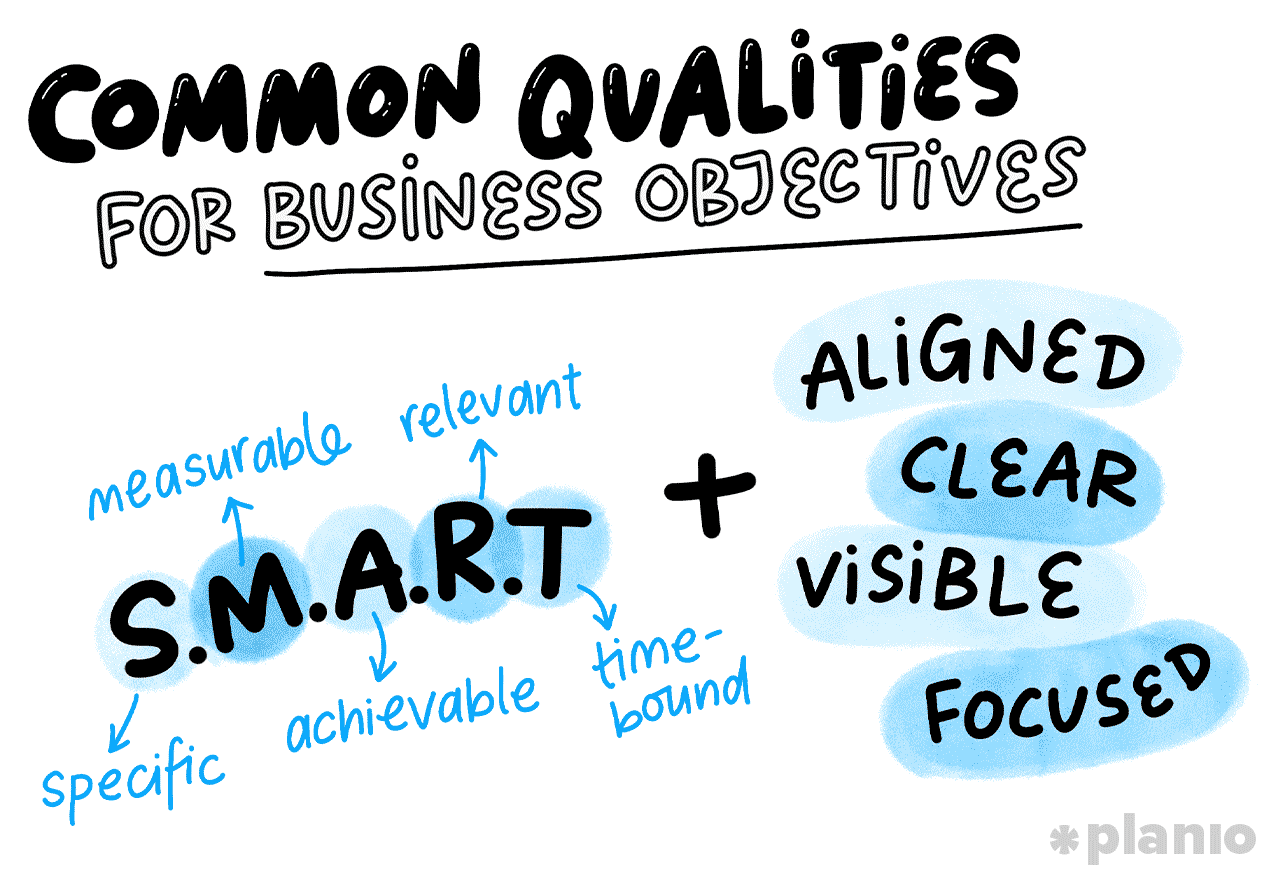
- Specific. They are clear and unambiguous. Everyone who reads it understands exactly what it means.
- Measurable. This is non-negotiable. It must be quantifiable, enabling you to know without a doubt whether you’ve achieved the objective or not.
- Achievable. An objective that is clearly impossible will demotivate, not inspire. But one that is too easy will give teams room to coast. It should be a stretch, not a fantasy.
- Relevant. It must be directly relevant to your company’s mission and vision. If it doesn’t help you fulfill your core purpose, it’s a distraction that will cause teams to pull in the wrong direction.
- Time-bound. It must have a deadline, such as “by 2028”, “within 24 months”, or “by the end of this fiscal year”. This creates urgency and sets a clear expectation of when teams need to hit the finish line.
On top of those classic SMART characteristics, the best business objectives should also be:
- Aligned. They should connect up and down. Business objectives provide the bridge between your strategic vision and the day-to-day projects your team works on.
- Clear. Business objectives should be written in simple language, with no jargon, buzzwords, or acronyms. The way to test this is that a brand-new employee should be able to understand it.
- Visible. An objective hidden in a slide deck is useless. It should be visible everywhere — in your all-hands meetings, your planning tools, and your team dashboards.
- Focused. Don’t try to boil the ocean with an objective. Instead, a single objective should target a single key result. If it has “and” in it multiple times, it’s probably too complicated.
5 business objective examples from the real world
Business objectives are almost always tied to specific areas of growth or improvement. No matter what product or service your company sells, you most likely will have business objectives tied to one of three things: grow revenue, lower costs, and keep customers and staff happy.
Here are five real-life examples of business objectives you might see in any organization.
Example #1: Revenue
What it is: This is the most common business objective. Here, we’re focusing on bringing in more money to ultimately grow, become profitable, and stay in business.
Real-Life Example: “Increase Annual Recurring Revenue (ARR) by 40% within 24 months.”
Associated sub-objectives:
- Reduce monthly customer churn from 3% to 1.5%
- Increase enterprise customer acquisition by 25%
- Implement a new pricing tier to increase upsell revenue by 10%
Real-Life Example: “Achieve profitability in the European market within 3 years.”
Associated sub-objectives:
- Establish a local 10-person sales and support team
- Optimize product pricing to within 10% of the region average
- Keep individual market-entry costs below $2m per annum
Example #2: Customer Satisfaction
What it is: Happy customers stay longer, spend more, and tell their friends about your business. These types of business objectives focus on improving the customer experience and building loyalty.
Real-Life Example: “Improve our company-wide Net Promoter Score (NPS) from 35 to 50 by the end of the fiscal year.”
Associated sub-objectives:
- Reduce average customer support first-response time to under 1 hour
- Implement the top 3 most-requested features from customer feedback
- Redesign the new user onboarding flow to improve activation by 15%
Real-Life Example: “Achieve a 95% “Satisfied” or “Very Satisfied” (CSAT) rating on all post-service support tickets.”
Associated sub-objectives:
- Launch a new training program for all support agents within 3 months
- Expand the self-service knowledge base by 50 new articles
- Implement a “one-touch resolution” process within 9 months
Example #3: Cost Efficiency
What it is: This isn’t just about cutting costs; it’s about optimizing spending. These objectives aim to improve profit margins by making your operations smarter and leaner.
Real-Life Example: “Reduce Customer Acquisition Cost (CAC) by 15% in the next 18 months.”
Associated sub-objectives:
- Reallocate ad spend from low-performing to high-performing channels
- Improve marketing-to-sales funnel conversion rate by 5%
- Increase organic search traffic by 40% to reduce reliance on paid ads
Real-Life Example: “Decrease operational overheads by 10% by automating manual back-office processes.”
Associated sub-objectives:
- Identify and launch a new automation software by September
- Offshore 5% of administrative roles to reduce salary costs
- Redesign and optimize the 10 most critical internal finance processes
Example #4: Employee Retention
What it is: Your team is your biggest asset. High turnover is a silent killer of productivity and morale. These objectives focus on creating a great place to work.
Real-Life Example: “Reduce voluntary employee turnover from 20% to 10% within two years.”
Associated sub-objectives:
- Implement clear and transparent career progression paths by EOY
- Launch a new leadership training program for all managers
- Enhance employee benefits to increase average remuneration by 5%
Real-Life Example: “Increase our annual employee engagement score from 65% to 80%.”
Associated sub-objectives:
- Roll out flexible and remote working options by July
- Create a new peer-to-peer recognition program
- Launch a weekly newsletter to increase the frequency and transparency of internal communications
Example #5: Sustainability
What it is: With a growing focus on the environment, these objectives relate to Environmental, Social, and Governance (ESG) goals. They show you’re building a responsible, long-lasting business.
Real-Life Example: “Achieve carbon-neutral status for all company operations by 2030.”
Associated sub-objectives:
- Switch all office and data center energy to renewable sources by 2028
- Purchase high-quality carbon offsets for all business travel
- Conduct a full audit of the supply chain to identify emissions
Real-Life Example: “Ensure 100% of all product packaging is recyclable or compostable by 2027.”
Associated sub-objectives:
- Source and test new sustainable packaging suppliers by EOY
- Redesign product packaging to eliminate single-use plastics by 2026
- Launch a customer communication campaign about the change
How to define your own business objectives
Setting your business objectives isn’t a one-person, one-hour job. For the best results, treat your business objective planning session as a collaborative process of reflection, brainstorming, and prioritization with leaders across your organization.
Strong, clear business objectives are the bedrock of successful companies.
To get you started, here’s a practical, step-by-step process you can follow:
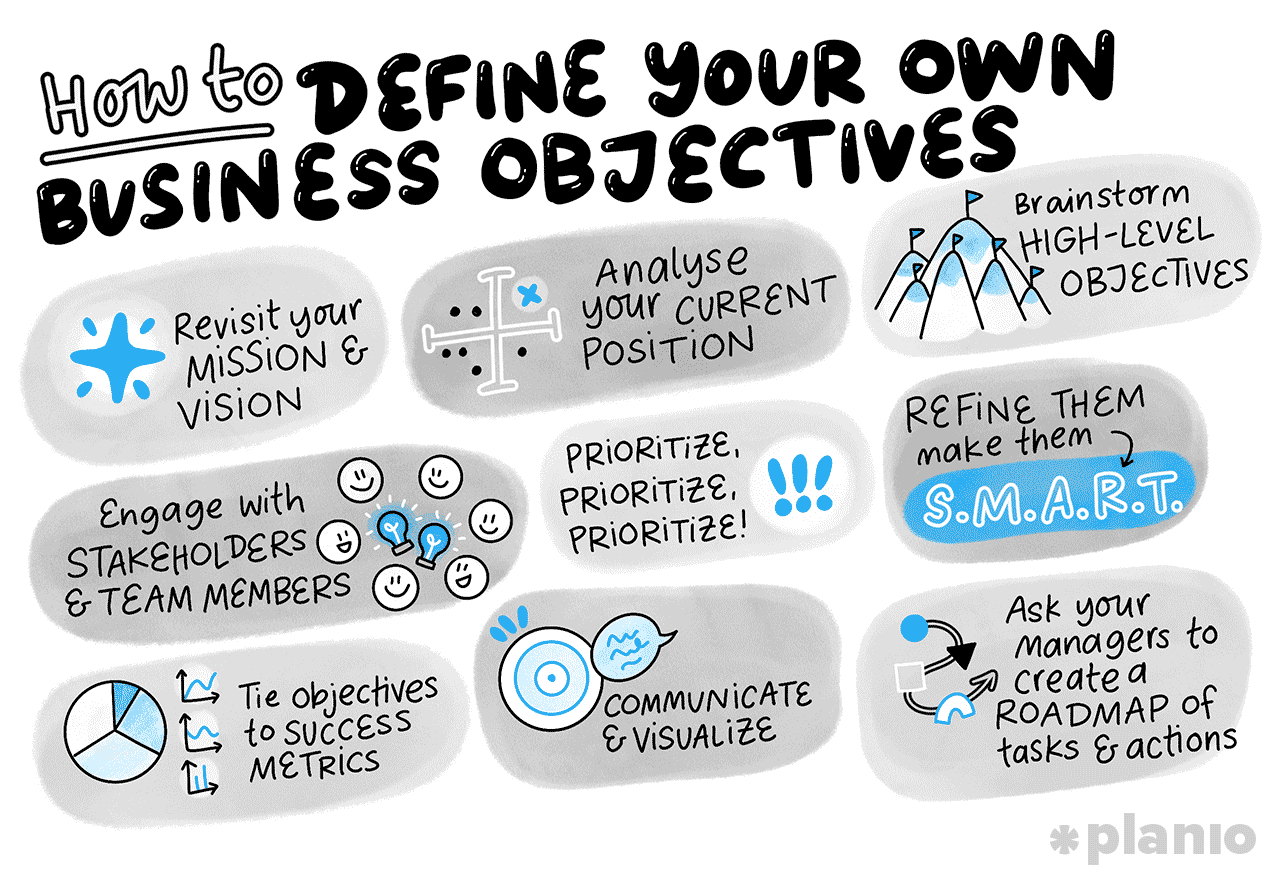
- Revisit your mission and vision. Your mission and vision are your starting point, so make sure you and your fellow leaders are up to date and aligned on this. Do they still feel right? If not, change them, as any objectives you set must be in service of these two statements.
- Analyze your current position. Be brutally honest with where you are right now and what needs to happen to move you forward. A competitive analysis is a great tool for this, helping you reflect on what you are good at, where you are failing, and what the surrounding market is doing.
- Brainstorm high-level objectives. Next, get your leadership team in a room and use your competitive analysis to brainstorm what you could achieve in the next 3-5 years. Go for quantity over quality at this stage, with no idea being a bad one.
- Engage with stakeholders and team members. Don’t set objectives in a vacuum. Share your initial ideas with trusted team members and key stakeholders. What did you miss? What resonates with them? This builds buy-in from day one.
- Prioritize, prioritize, prioritize. This is the hardest part, as you simply can’t do everything at once. You must now prioritize your long list down to the 3-5 "vital few". The best way to make this decision is to quantify which objective will have the biggest impact on fulfilling your mission.
- Refine them (make them SMART). Now, turn your “good ideas” into great objectives. Take a vague idea like “improve our reputation” and make it employee-ready with attributes that are specific, measurable, achievable, relevant, and time-bound.
- Tie objectives to success metrics. With your objectives set, draft some sub-objectives, Key Performance Indicators (KPIs), or North Star metrics that will enable you to track your progress and take action if things still aren’t quite right.
- Communicate and visualize. An objective no one sees is useless. Take the time to properly communicate your new objectives to your managers and employees, explaining what they are and why they’re important. Create a formal communication plan, utilizing a mix of communication styles to ensure your message gets through to everyone in your organization.
- Ask your managers to create a roadmap of tasks and actions. This is where the rubber meets the road for your objectives. Task your managers with breaking down each year of the objective into short-term goals and then into the projects and initiatives that will get you there.
This is where tools like Planio become essential.
Planio allows you to not only record your high-level objectives but also to build the product roadmaps, projects, and tasks that underpin them.
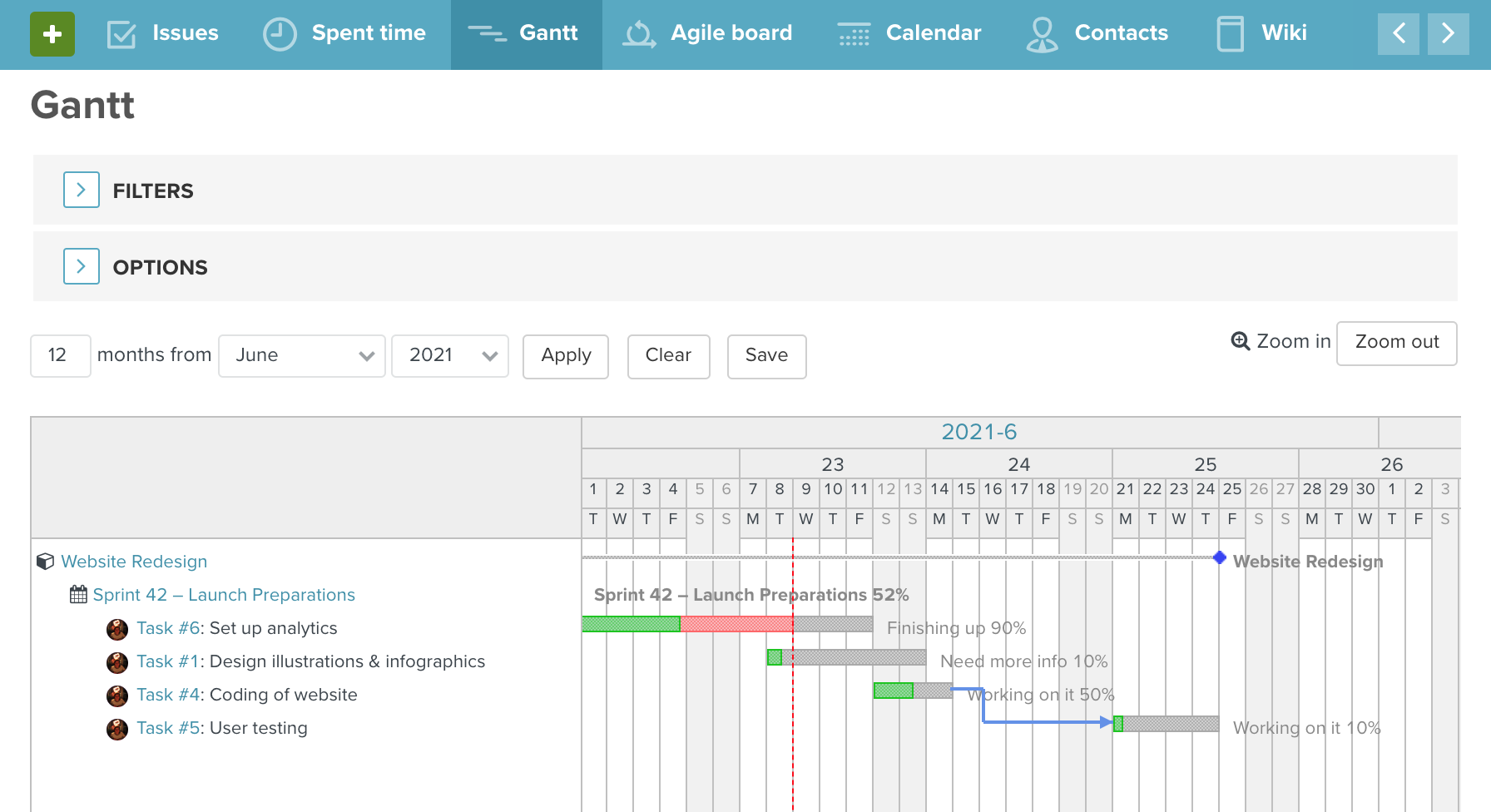
This allows you to create a clear hierarchy that connects everything from top to bottom, so everyone on the team sees exactly how their work contributes.
Common business objective pitfalls to avoid
Business objectives are an incredibly powerful tool for aligning your team and connecting your high-level vision to the ground-level work. But it’s easy to get lost and fall into common traps along the way.
As you go through this process, watch out for these pitfalls:
- Using vague or “vanity” statements. Remember, if you can’t measure it, it’s not an objective; it’s a slogan. Avoid things like “Be the best” or “Delight our customers”.
- Setting too many objectives. If everything is a priority, nothing gets done. If you have 10 “top” objectives, your team has no clear focus. Stick to 3-5 at most.
- Confusing objectives with strategies and tactics. An objective is the milestone *(e.g., “Increase market share to 30%”) and tactics are the *steps to get you there (e.g., “launch new products”). Keep the two separate to avoid confusion.
- Not aligning everyone on the objectives. After you’ve put all the work into defining objectives, why ruin it with poor communication? You can’t just send an email and expect, so make a clear communication plan, utilizing all-hands, one-on-one meetings, and project kick-offs to get your message out.
- Failing to review and adapt. Don’t fall into the “set it and forget it” trap and remember that objectives have to adapt. As your market changes, competitors merge, and major events hit, review your objectives to ensure they are still relevant.
Strong, clear business objectives are the bedrock of successful companies. They cut through the noise and provide the bridge between your strategic vision and the day-to-day projects your team works on.
Communicating them, tracking them, and linking them to real, tangible work is one of the biggest parts of their success, and using a tool like Planio is the perfect way to keep everyone on the same page, turning your vision into a measurable, achievable reality.
Try Planio with your own team — free for 30 days (no credit card required!)