Jory MacKay on September 29, 2026
 How to know if the sunk cost fallacy is killing your products
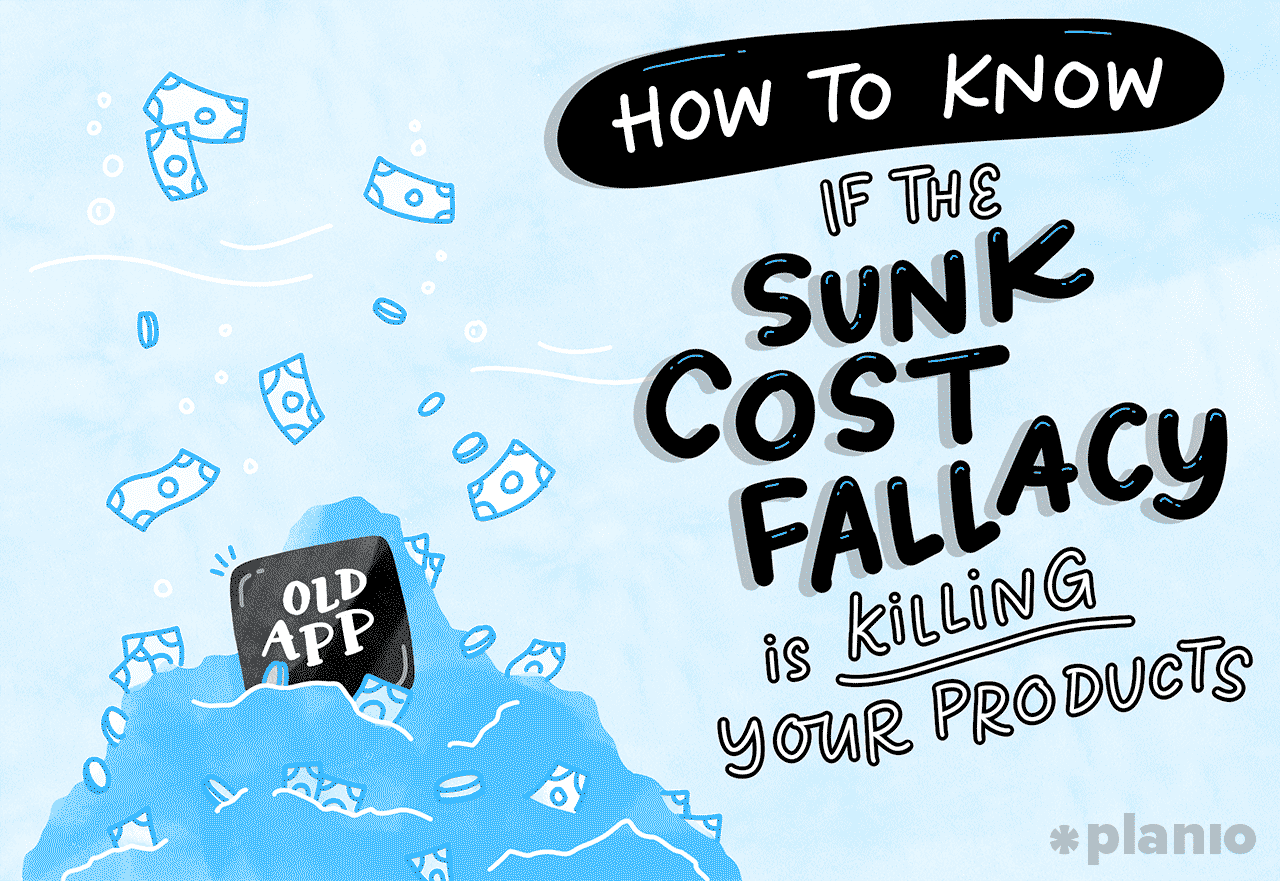
If you build products long enough, you’ll eventually find yourself in this position: While competitors quickly launch new features on modern platforms, you’re stuck wrestling with technical debt and legacy tools.
So the question becomes, do you scrap years of software development work and start again? Or do you continue pushing through with your franken-platform just trying to catch up?
This is the perfect illustration of one of the most dangerous mental biases product leaders face: the sunk cost fallacy.
Jump to a section:
The sunk cost bias causes decision makers to avoid change in favor of “preserving” the time, money, and work that’s already been put into their current product.
But the reality is that those resources have already been used — and avoiding investing more often means purposefully holding yourself back. So, are you being prudent? Or are you just unable to objectively say it’s time to let go of the past and move forward?
What is the sunk cost fallacy? Where does it come from?
The sunk cost fallacy is our tendency to follow through on something we’ve already invested time, effort, or money into, even when we know the costs outweigh the benefits.
Those “costs” can be monetary, but also time, physical effort, or even attached to your professional reputation. Once you put your name on a project, backing down can feel like a personal defeat.
In product development, the sunk cost bias can present itself as a team pushing an unwanted feature to launch just because developers spent six months building it. In the corporate world, it could look like an organization pumping money into an acquisition that no longer aligns with its strategic goals.
The sunk cost fallacy isn’t new; in fact, it’s been talked about since the 1980s. So, why do so many smart business leaders fall into this trap?
The sunk cost fallacy can be attributed to a number of different but loosely attached psychological factors:
- Loss aversion. The pain of losing is psychologically twice as powerful as the pleasure of gaining. When deciding to kill a project, it hurts to "waste" the resources you've already spent. But that time and money are gone and can't be recovered.
- Overly optimistic decision making. We tend to view our own projects through rose-tinted glasses, believing that just one more sprint or one more marketing push will finally turn things around.
- Escalation of commitment. Once we publicly commit to a path, we feel intense pressure to stick with it to prove we were right all along.
- Fear of failure. In many corporate cultures, ending a project is seen as a black mark on a leader’s record. We keep doomed projects alive to avoid admitting defeat.
- Status quo bias. Changing direction takes mental energy, difficult conversations, and administrative heavy lifting. It’s often easier to just keep doing what you’re doing.
- Ego protection. Admitting a project is dead means admitting we made a mistake in our initial analysis. For high-achieving leaders, protecting the ego often overrides logic.
- Groupthink. When an entire team has been working on the same codebase for a year, the collective belief that "this will be great" can easily drown out the single dissenting voice pointing out the flaws.
- The illusion of control. We falsely believe that if we just work harder or manage the team tighter, we can force the market to accept a product they clearly don’t want.
The bottom line: The sunk cost fallacy pressures leaders into continuing to pursue losing ideas, which turns into a vicious cycle. The more you commit, the more likely you are to continue committing resources, until it’s too late.
10 real-life examples of the sunk cost fallacy
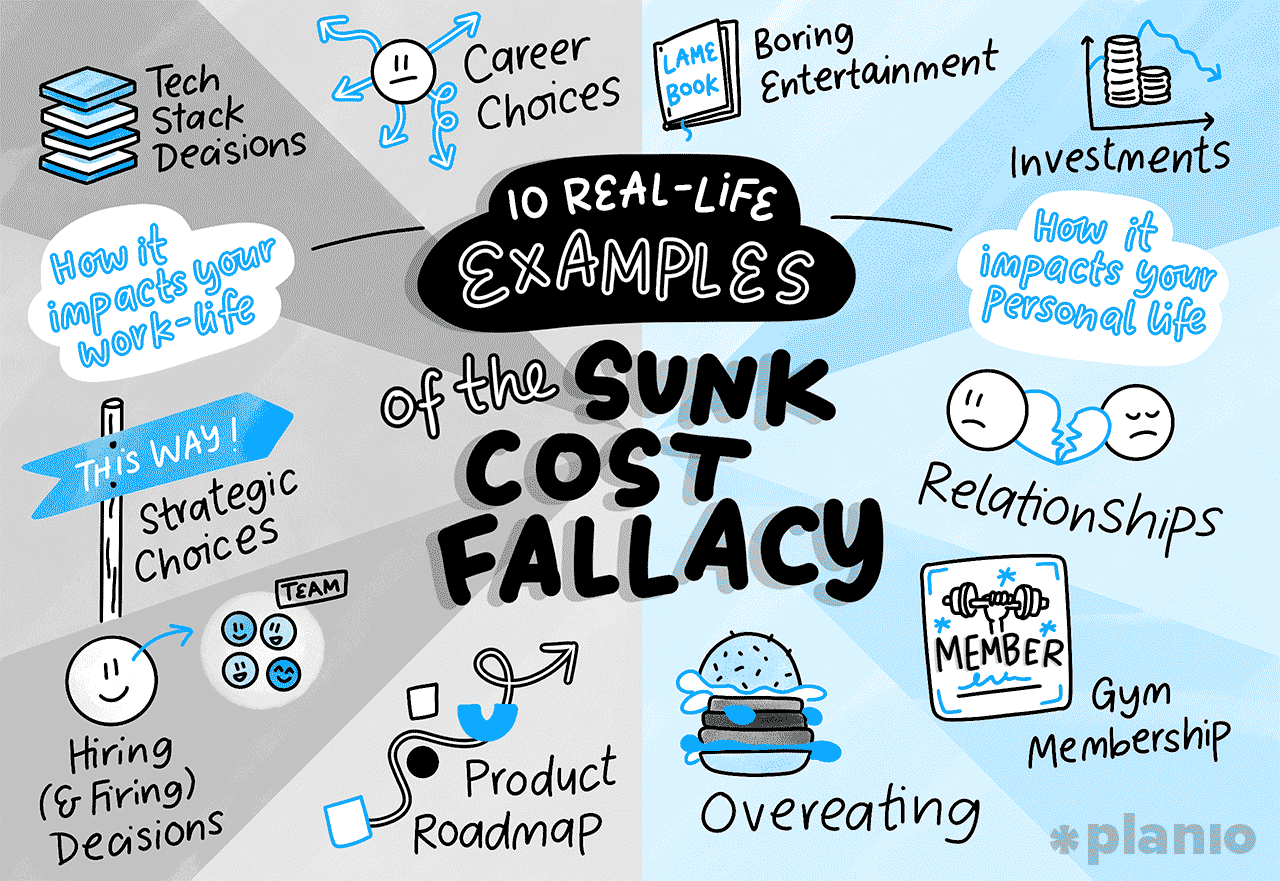
While the sunk cost fallacy is referenced a lot in business and economics, it actually reaches into other aspects of our lives too. We’ll go on to focus on product-based examples, but first, it’s often easier to understand how the sunk cost fallacy creeps into your everyday routines.
How the sunk cost fallacy impacts your work life:
- Strategic choices. Continuing to fund a marketing campaign that generates zero leads simply because the creative agency already billed you for the assets.
- Hiring (and firing) decisions. Refusing to let go of an underperforming, toxic employee because you spent six months and thousands of dollars recruiting and onboarding them.
- Tech stack decisions. Forcing your team to use an outdated, clunky software tool because you still have two years left on the massive five-year enterprise contract you signed.
- Career choices. Staying in a miserable job or a dying industry because you spent four years getting a specific, niche degree for it.
- Product roadmaps. Launching a product that users actively reject, rather than pivoting to a new model, because the roadmap was "locked in" six months ago.
How the sunk cost fallacy impacts your personal life:
- Boring entertainment. Forcing yourself to finish a terrible book (because you bought it) or a boring movie (because you’ve already watched an hour).
- Investments. Holding on to plummeting stocks hoping they bounce back so you don’t have to lock in your losses.
- Relationships. Staying in an unhealthy relationship because you’ve already been together for five years and don’t want to start over.
- Gym memberships. Going to a gym you hate or that’s completely out of your way just because you paid for an annual membership.
- Overeating. Forcing yourself to finish a massive meal at a restaurant even though you’re painfully full, just because you paid for the food.
How to recognize the sunk cost fallacy in your work projects
It’s incredibly hard to recognize when you’re in the throes of the sunk cost fallacy. Perseverance is often viewed as an admirable quality, and we celebrate the founders who "never gave up."
But persevering on the wrong task is often just foolish stubbornness.
If you suspect you might be succumbing to the sunk cost fallacy, force yourself to ask these questions:
| Question to ask | Why it works |
|---|---|
| Would I start this project today? | Reframing the project away from the investment you’ve already put in gives you fresh eyes on whether it’s actually worth continuing based on today’s market. |
| Would a new CEO/leader approve this project? | Thinking about the project through the lens of a new leader without any emotional baggage helps break you out of your own biases. |
| What would happen if we ended this project today? | This forces you to look at the actual, factual fallout rather than the imagined, catastrophic disaster in your head. Usually, the fallout is much smaller than you think. |
| If I had an extra $100k, would I put it here or somewhere else? | This highlights your opportunity cost. If you wouldn’t invest fresh capital into the project, you shouldn’t be investing your current resources into it. |
| Are we trying to prove we were right, or build the right thing? | This is a check for your ego. It separates the desire to validate your past decisions from the desire to serve your users. |
One to think about: If you find yourself stuck, sunk cost fallacy and analysis paralysis often look the same. Check out our guide to understanding analysis paralysis to understand why you might be hesitating.
9 ways to avoid the sunk cost fallacy in the future
While the questions above can help you break out of the sunk cost fallacy in the moment, you need forward-looking strategies to make sure you’re making rational decisions going forward.
These techniques should be baked directly into your product and planning strategies.
1. Complete a sunk cost audit
A sunk cost audit is a deliberate pause where you review your work based on its future value, explicitly ignoring any past spending. Using the questions above, you can strip away the emotional weight to make a clear, rational decision about where to allocate your remaining resources.
Actionable tips to help:
- Conduct quarterly audits: Schedule a quarterly audit where teams present their project's future ROI without mentioning what they've already spent.
- Understand unconscious bias: We’re all shaped by biases we don’t even know about. Learn to spot the signs of bias early by checking out our guide on unconscious bias examples.
2. Collect data on the “true cost” of continuing
It’s easy to get caught up in the romance of saving a struggling product if you don’t realize how much it’s actually costing you. You need hard, objective data to help visualize the hours and budget at stake and enable an objective business decision.
Actionable tips to help:
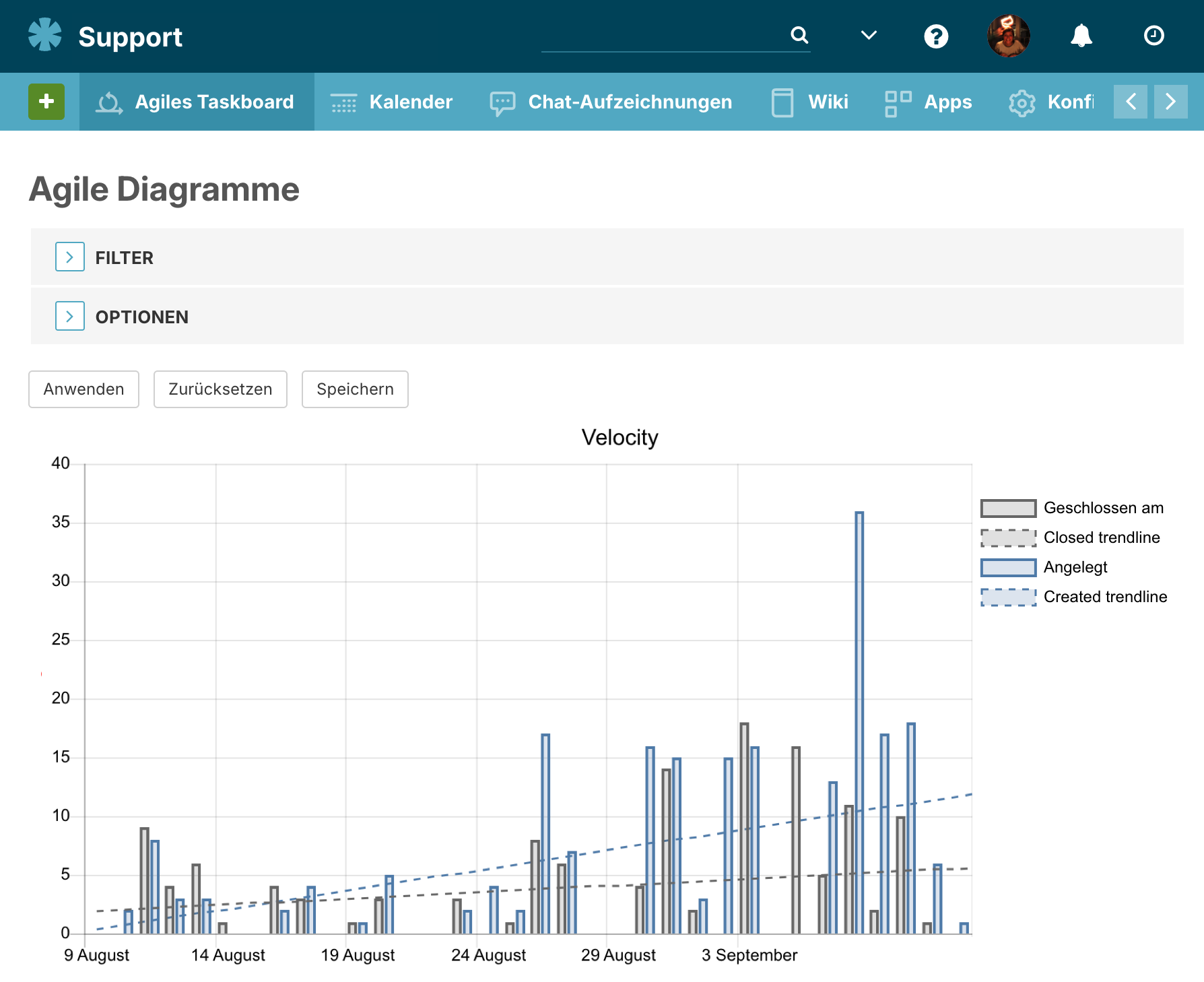
- Take advantage of time tracking: Use time tracking integrated in Planio to see exactly how many developer hours you’re sinking into a struggling feature, rather than relying on estimates.
- Check your velocity reports: You can also cross-reference that time tracking data to create velocity or burndown reports. If a project’s velocity drops week over week despite heavy investment, the data could be telling you to stop.
3. Conduct a "pre-mortem" analysis
Unlike a post-mortem, a pre-mortem flips traditional risk management on its head by asking you to imagine that your product or project has already failed. Then, you work backward to figure out exactly what caused the disaster. This exercise removes the blind optimism that often plagues our work and gives you a reliable early warning system for fatal flaws.
Actionable tips to help:
- Document failure triggers: Have your team write down every possible reason the product or project died. If one of those reasons starts happening in real life, you have a predefined trigger to pause work.
- Centralize documentations: Document your pre-mortems in a centralized location, like the Planio Wiki, so you can easily reference them as a team when things get tough.
4. Use the stage-gate framework
If you still need some time to think, utilize a stage-gate framework that breaks massive, unwieldy projects into smaller, manageable chunks separated by mandatory "Go/No-Go" decision points. You can't move to the next phase of development until you pass the gate's strict criteria. This stops your team from blindly building a product from start to finish without pausing to validate their assumptions along the way.
Actionable tips to help:
- Set up incremental funding: Never fund an entire project or product upfront. Instead, release funding by each stage, quarter-by-quarter, or any other cadence that works for your business. This requires the team to prove value before they unlock the next round of resources.
- Visualize product development stages: Use Kanban boards to visualize these stages so everyone knows when a crucial gate is approaching. This helps everyone get prepared for your review point and come armed with the data you need to make decisions.
5. Establish “kill criteria” early on
Kill criteria are specific, measurable metrics that, if hit, automatically trigger the cancellation of the project. Having these predefined rules removes the emotional debate when things go south — if the criteria are met, the project dies, no questions asked.
Actionable tips to help:
- Set strict metrics and data: Use strict metrics (e.g., "If we don't hit 1,000 beta signups in 30 days, we stop") and incorporate user behavioural design principles into your thinking. If you hit the criteria, execute the kill without debate.
- Assign an owner: Designate a specific team member who is responsible for monitoring these metrics. This ensures someone is actively watching the "kill criteria" triggers and can raise the alarm immediately when thresholds are met.
It’s easy to get caught up in the romance of saving a struggling product if you don’t realize how much it’s actually costing you.
6. Ensure psychological safety on your team
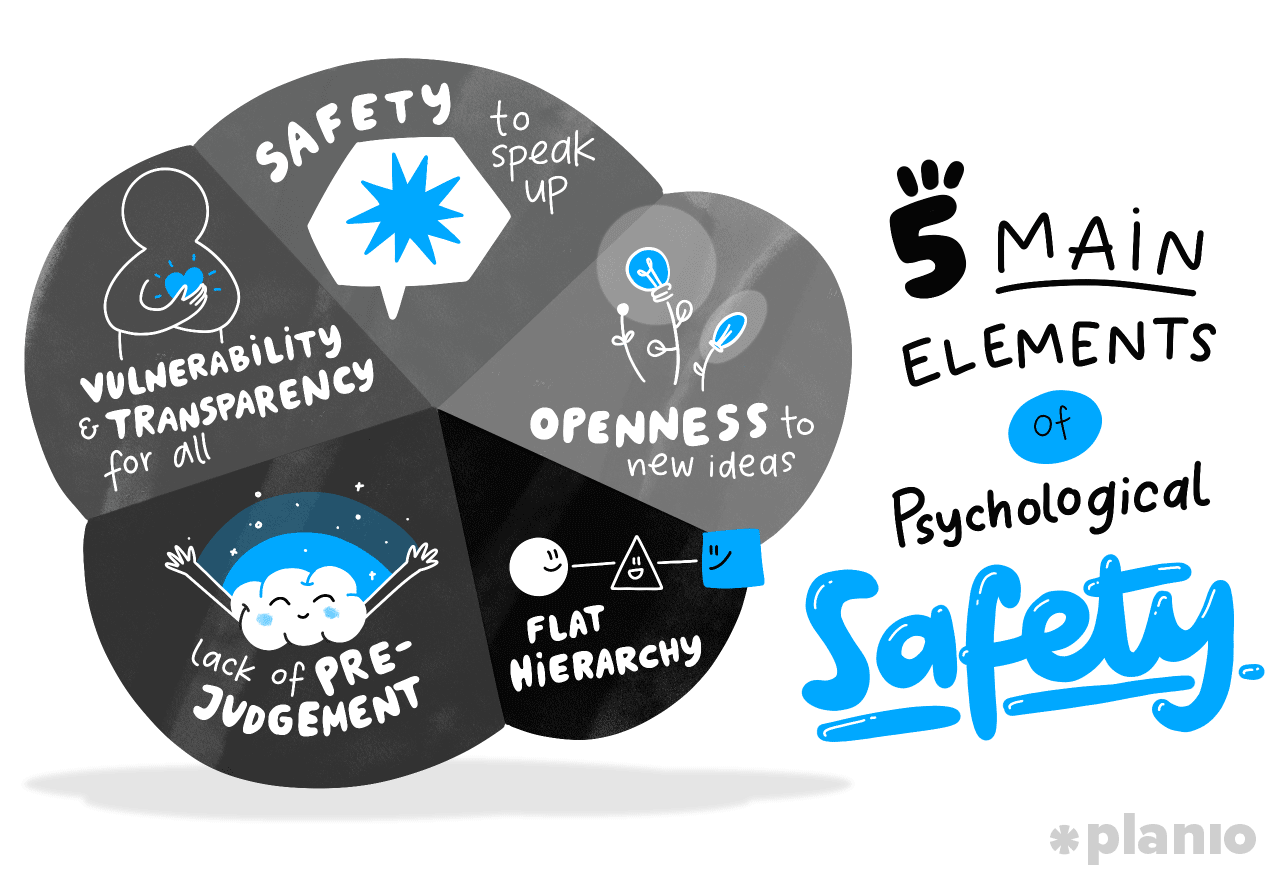
If your team believes they’ll be punished or fired for a failed project, they’ll hide the failure and string the project along for as long as possible. Psychological safety means creating an environment where team members feel comfortable speaking up, sharing bad news, and admitting mistakes. When people aren't afraid of the consequences, they'll happily tell you when a product is a dud.
Actionable tips to help:
- Praise transparency: Publicly praise team members who raise red flags, challenge assumptions, and share constructive feedback. This encourages people to be brave and make the right decisions.
- Standardize sunsetting: Make sunsetting a normal part of your business process so that it doesn’t feel like a bad thing. Read our guide on how to cleanly deprioritize and sunset projects to help.
7. Take advantage of cross-functional feedback
When a product team spends months staring at the same codebase, they become too close to the work to see its fatal flaws. Bringing in external evaluators from different departments injects fresh, unbiased perspectives into your review process. Because these cross-functional team members don’t have any sunk cost in the project, they’ll give you the unvarnished truth.
Actionable tips to help:
- Bring someone in to help with market grounding: Invite a leader from Sales or Customer Success into your sprint reviews to ground your progress in what the market is actually asking for.
- Rotate managers: Rotate product managers across different projects occasionally to get fresh eyes on old problems. This is also a great opportunity to promote growth in your team and keep motivation high.
8. Use structured decision-making frameworks
When it comes to making the big decision, give yourself a framework to help. Structured frameworks remove that ambiguity by defining exactly how a decision gets made and who has the final say. This prevents passionate project owners from endlessly lobbying to keep a failing product alive.
Actionable tips to help:
- Try a RACI matrix: Use a RACI matrix so it’s crystal clear who has the authority to kill a project. Read up on decision-making frameworks and RACI charts.
- Make “Rapid decisions”: Implement a rapid decision-making process to stop teams from endlessly debating whether to pull the plug.
9. Celebrate the pivot
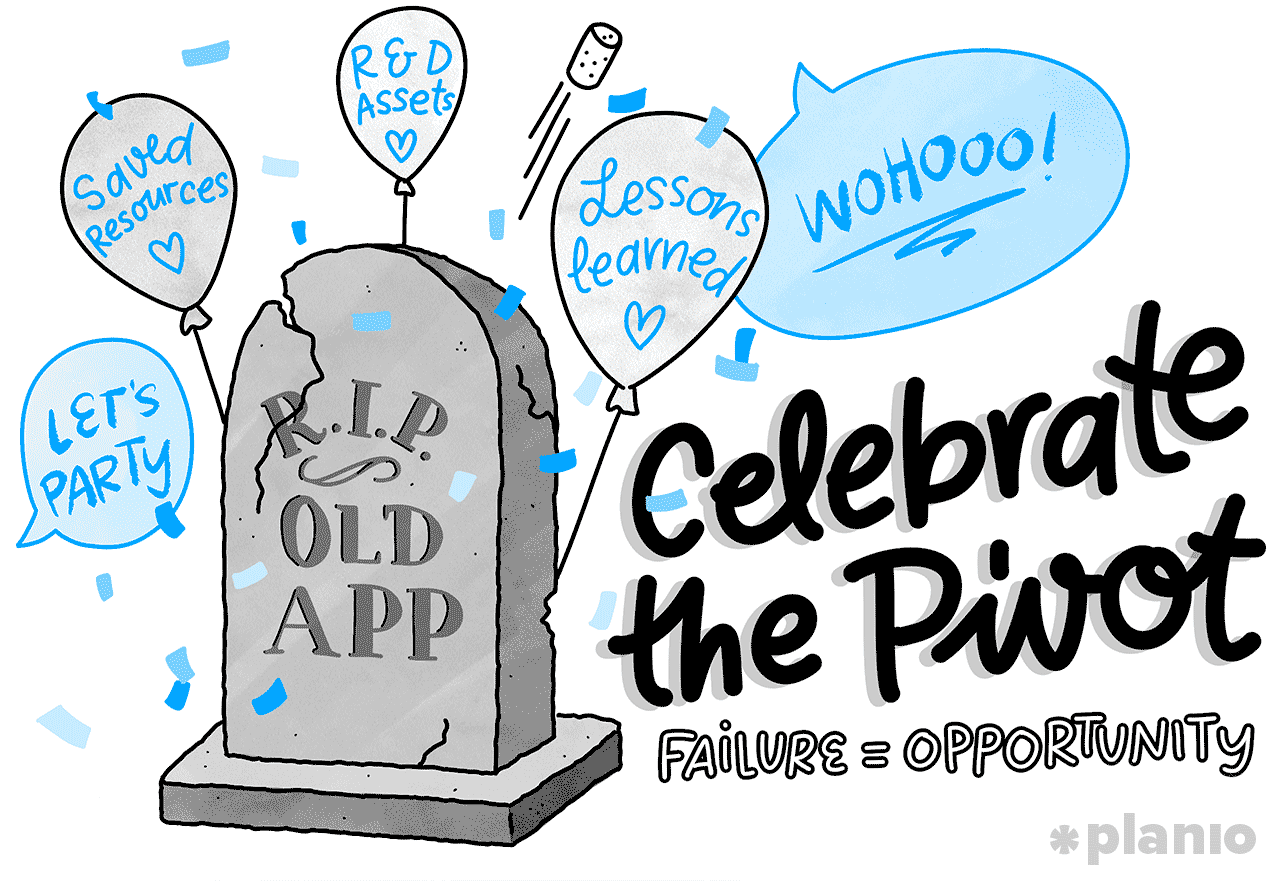
Shift your company’s cultural mindset on canceling or pivoting a project from failure to opportunity. When you treat a killed project as a valuable learning experience rather than a failure, you strip away the fear of the sunk cost fallacy entirely.
Actionable tips to help:
- Throw a pivot party: When you kill a project, throw a "pivot party." Celebrate the resources you just saved and the lessons you learned.
- See “failed” projects as R&D assets: Document all the code and research from the killed project. It isn't a waste; it's an R&D asset you can use later, alongside your critical lessons learned that will help you in the future.
How to remove the sunk cost fallacy from your product development roadmap
Removing the sunk cost fallacy from your decision-making process isn’t a one-time event. You need to actively weed it out of your entire product development lifecycle.
Here are some critical moments and suggestions to help you stay objective throughout the life of a product:
- At your next product review: Stop just asking, "What have we done so far?" and also ask, "What is the expected ROI of the remaining work?" Expand the conversation to focus on the past and the future.
- During your next project planning session: Force the team to write down their objective "kill criteria" before they are allowed to create any tasks in the backlog.
- When evaluating ongoing projects: Bring in someone from outside the product team to do a blind audit. Ask them: "If you just inherited this project today, would you keep funding it?"
- When launching a new feature: Treat the launch as an experiment, not a permanent commitment. Give every new feature a probationary period where it has to earn its right to stay in the codebase.
- As you develop your company culture: Start openly talking about your own failures and mistakes as a leader. When the team sees that you are willing to admit you made a bad bet and pivoted, they’ll feel safe doing the exact same thing.
Pro tip: It’s harder to fall into the sunk cost fallacy when you have a strong vision and roadmap. Data-driven strategies and Agile-empowered teams learn to regularly pivot and adapt based on real customer needs. With Planio, you get all of the project data you need in one place to make the right decisions. Learn more and try Planio free for 30 days with your own team.
Final thought: Look out for these sunk cost fallacy red flags in your own language
While the sunk cost fallacy is deeply wired into human nature, if you don’t learn to recognize it, it can cause long-term damage to your career, burn out your engineering team, and slowly bleed your products dry.
One of the easiest ways to know if you’re falling victim to it is to simply listen to the way you talk (or think) about your work.
If you hear yourself or your team using these phrases, red flags should immediately go up:
- “We’ve already invested so much money into this…”
- “We can’t let all this code go to waste…”
- “We’re so close. Just one more sprint…”
- “We’ve come this far, we have to see it through…”
- “It would be a shame to give this all up now…”
When you hear those phrases, it might be time to hit the brakes and look at some objective data. After all, you can’t argue with hard numbers.
This is where the Planio reporting, issue tracking, and time management tools give you the insights you need to break free from sunk cost bias and see your projects for what they really are. By tracking the true cost of your development cycles, you can pivot faster, build better products, and leave the sunk cost fallacy behind.
Ready to start making better, data-driven product decisions? Try Planio with your own team, free for 30 days (no credit card required!)